Monday, June 18, 2012

The death of Anne Boleyn

I finally settled down to Hilary Mantel's sequel to Wolf Hall, which I had been eagerly awaiting. The first novel introduced Thomas Cromwell, the rough-and-ready blacksmith's son who rises from acolyte to Cardinal Wolsey, to trusted councilor of King Henry VIII. Cromwell smooths the path for Henry to rid himself of Katherine of Aragon, to become head of his own Church and throw off Rome, and to marry Anne Boleyn in hopes of  a male heir. But, as the title foreshadows, by the end of the first installment, even in his triumph, Henry's eye falls on Jane Seymour of Wolf Hall, and as his enthrallment with Anne fades, the stage is set for Bring Up the Bodies, which picks up just where Wolf Hall ends.

True to his philosophy of "pick your prince," Cromwell realizes that, for better or worse, his best interests lie in aligning himself with Henry's interests -- in this case, Jane Seymour. Of course, there is always a faction angling for power, and Cromwell falls in with Anne's enemies as he plots her ouster and Jane's installment as queen. Cromwell has lost his wife and young daughters; grief has stripped away any moral ambivalence he might feel as he manipulates events to remove Anne. He doesn't hate the Queen, but she is an obstacle that must be removed. If she would consent to be put away quietly in a convent, Cromwell would be satisfied, but he knows she will not. It is to be a fight, literally, to the death, and he is equal to the task. Mantel's great power lies in her ability to shade the character of Cromwell. His ruthlessness is monstrous, but also merely practical; he feels sympathy for his enemies, but understands his neck will be on the block in their stead if he does not prevail. He knows how unlikely it is that he will retire quietly to the country after faithful service to the king, but he is willing to play the game out to the end.

The four interviews he holds with Anne's accused lovers are marvelous. Each man's guilt, in Cromwell's eyes, isn't so much about what they may or may not have done with Anne, or how they may have been treasonous to the king, but the extent to which they had a hand in the downfall of his mentor Wolsey. If they are to be executed for crimes which they may not actually have committed, they will at least pay for something: "He needs guilty men. So he has found men who are guilty. Though perhaps not guilty as charged."

 As for Anne, Cromwell believes she is the author of her own fate -- up to a point. She has only the the poor weapons that women can wield, and they are not enough to vanquish her enemies. Until the end, she believes Henry will rescue her, but she is already dead to him before the sword falls -- this is something that Cromwell understands.
The queen is alone now, as alone as he has ever been in her life. She says, Christ have mercy, Jesus have mercy, Christ receive my soul. She raises one arm, again her fingers go to the coif, and he thinks, put your arm down, for God's sake put your arm down, and he could not will it more if -- the executioner calls out sharply, 'Get me the sword.' The blinded head whips around. The man is behind Anne, she is misdirected, she does not sense him. There is a groan, one single sound from the whole crowd. Then a silence, and into that silence, a sharp sigh or a sound like a whistle through a keyhole...
Again, at the end of Bring Up the Bodies, Cromwell's will has carried the day. The executions are accomplished and Jane Seymour will ascend, but this is not an end as Mantel makes clear in the final words of the novel: "There are no endings. If you think so you are deceived as to their nature. They are all beginnings. Here is one."


Tuesday, June 05, 2012

Eudora Welty

Welty: http://mdah.state.ms.us/welty/welty_map.html
Just after vacation, I read both The Robber Bridegroom and Delta Wedding by Eudora Welty. Welty is one of those authors lodged permanently in the canon of literature, and in particular, Southern literature, read by every school child (is that still the case?) and in every survey of American lit. Her wonderful short stories are classics. I'm sure I read "The Worn Path," "Why I Live at the P.O.," and "The Petrified Man," and probably more that I've forgotten. But I never had read any of her longer fiction. Coming back to her after so many years, I was completely charmed by both novels, really, by every word. There is a great warmth and humor, and such grace in the flow of her language, pulling the reader along as powerfully as the Mississippi current .

The Robber Bridegroom is told in the fantastical style of a Southern fairy tale, with a decided Grimm Brothers' darkness. There's a horrible little goblin-like being who talks to his brother's severed head in a box (and the head talks back), a wicked stepmother, a beautiful maiden (but not maid for long), an anti-hero bandit/kidnapper, and all sorts of bizarre characters existing at various points on the continuum of villainy. For the most part, everyone gets their just deserts, but the getting there is funny and quirky and quintessentially southern in its mythic qualities.

Delta Wedding  is a title that puts in a nutshell exactly what the novel is about at its most basic level. The novel is set in 1923 and opens with nine-year-old Laura McRaven traveling by the Yellow Dog train alone from Jackson to the Delta, along the Yazoo River, to attend the wedding of her cousin Dabney Fairchild. The sprawling Fairchild clan, at their ancestral plantation of Shellmound, are preparing for the wedding -- an event not universally approved, but grudgingly accepted by the family. Dabney is marrying the Fairchild overseer, a step down in they eyes of many, who revere their storied ancestors with no less zeal than the ancient Romans did their household gods. The prolific Fairchild patriarch Battle and his Virginia-born wife Ellen preside over the place and their eight children (and yet another on the way), two Civil-War widowed aunts, a mentally disabled child of Battle's sister, a household of black servants (in addition to those who work on the plantation), and an array of other Fairchilds and wedding guests who show up in the course of the story.

This gathering of generations around a particular time and event is Welty's opportunity to explore the complexities of families, foremost, but also of privilege, nostalgia, and how families can build their own mythical backgrounds. Welty makes use of the modernistic device of shifting viewpoints and voices to create a densely layered portrait of a family almost claustrophobic in their closeness and their shared history, but at the same time, she manages to get at that conundrum that even people so tightly bound together and intertwined can still be mysteries to one another. This is something I've pondered myself about my own family. They are at one and the same time, both completely known and unknowable, and the mystery only deepens when they leave home and return with outsiders who know them in completely different ways.

Here is only a short sample of her beautiful, descriptive prose. The scene is of young Dabney taking a last, solitary morning ride at Shellmound on the morning of her wedding.
Flocks of birds flew up from the fields, the little filly went delightedly through the wet paths, breasting and breaking the dewy nets of spider webs. Opening morning-glories were turned like eyes on her pretty feet. The occasional fences smelled sweet, their darkened wood swollen with night dew like sap, and following her progress the bayou rushed within, ticked and cried. The sky was softly blue all over, the last rim of sunrise cloud melting into it like the foam on fresh milk.

...How sweet life was, and how well she could hold it, pluck it, eat it, lay her cheek to it -- oh, no one else knew. The juice of life and the hot, delighting taste and the fragrance and warmth to the cheek, the mouth. (p208-209, Library of America, Complete Novels)

Monday, June 04, 2012

Beach reading 2012

I've been known to take a stack of books to the beach, and even though I don't do more than lie under an umbrella for three or four days, sipping a frosty drink, I still don't have time to read all of them. For one thing, I'm easily amused -- by gulls and their endless patient stalking for a treat, the silvery roll of a finned back out in the Gulf, stiff-winged cormorants or big, gliding Brown Pelicans making a sudden dive and splash. All of this takes hours...and so I don't have time to read all those books!

This year, I packed light -- Breakfast at Tiffany's and Colette's Chéri, both of them rather slim. I still had to finish Chéri at home, too. I must finally get to In Cold Blood -- I love Capote's style, whether it's the heart-wringing A Christmas Story -- sweet, sentimental, funny, sad -- or in BaT, where he is clever and affectionate, but he doesn't let anyone off the hook. Holly is far more dark and exasperating than Audrey Hepburn's charming portrayal, but Capote writes her very sympathetically. I wonder how much of himself he saw in her -- she could be thoughtless, cruel, but also completely delightful, wrapping everyone into her fantasy, even when they knew better.

Chéri was, of course, beautifully written -- can anyone match Colette for the sensuous description? -- the curve of a settee, the play of rosy light on fluttering curtains, the arrangement of limbs, the sugared crust of a pastry eaten in bed. The story's protagonist is the beautiful and aging Parisian courtesan Léa, who is dealing with the letting go of her young lover, nicknamed Chéri, the son of one of her own friends (although I think "frenemy" is the most accurate modern description of their relationship). Chéri's marriage to a young girl has been arranged by their fractious mothers, but the young man is vain, petty, beautiful, and spoiled. He expects to have an obedient wife who lets him go his old ways as well as his mistress. Léa is worldly and wise, but still shaken by Cheri's marriage -- it becomes the looking glass of her vanishing youth. So many times, as she was observing the inevitable march of time in her actual mirror -- trying to apply the little arts to mask the effects on her skin, her hair, her morphing silhouette -- I was silently commiserating, "Tell me about it, girlfriend!" I rather keenly felt the poignancy of that very particular loss -- portrayed more seriously and more intimately than it usually is.

So, I expect there will be more Colette to come -- I haven't read any of the Claudine novels, although I did read a lesser known one several years ago (at the beach!) called The Pure and the Impure. It sounds much racier than it was. She reminds me of a randier Jane Austen -- a great observer of the ways of society, a sophisticated wit, and possessing a wonderful ability to lay bare (ahem!) the weaknesses and foibles of her characters.

Tuesday, May 15, 2012

Young men and their disappointments

After reading the Keats Brothers biography I looked around for something different, maybe a little lighter. I've read three books since then, all of them loosely dealing with young men confronting some live-altering challenges.

The first is a book that I borrowed from my Mom -- an Ivan Doig novel called The Whistling Season, set in Maria's Coulee, Montana (near Great Falls) in the year 1910. Doig is a well-known Montana writer that I've been meaning to read for years. His best known novels are Dancing at the Rascal Fair and Ride with Me, Mariah Montana, covering the years when Montana first became a state.

Young Paul Milliron is 14 with two younger brothers, the sons of a dry-dirt farmer who is recently widowed. When Mr. Milliron answers a newspaper ad for a Minnesota woman advertising herself as a housekeeper, he engages her to come West, and that is where the story really starts. It's a charming novel, nostalgic in tone, as it is an older Paul who tells the story of his coming-of-age during this time. Much of the story centers around the mysterious, widowed Rose who comes to keep house for them with her dandified brother, Morrie, in tow. Morrie stumbles into the post of teacher for the one-room schoolhouse -- a little community in itself, divided by age and the immigrant backgrounds of the children, as well as schoolyard rivalries. As is usual in the bildungsroman, Paul is beginning to mature, to enter into the world of adults with its full range of intricacies, secrets, and consequences. He has to shoulder new responsibilities, forge new relationships, and make difficult decisions. The "secret" at the heart of the story is discovered in the end, and it is primarily Paul who decides how it will play out in the lives of the other characters.

Next, was Joseph Conrad's Lord Jim, which definitely seemed like a precursor to The Heart of Darkness -- it introduces Marlowe, the story-telling narrator who pops up again in HofD. There is also a remote and mysterious foreign world, reached by traveling down a river beset with dangers, a white man who enters and who does not leave. Sound familiar?

Here the young man is Jim, the son of an English country clergyman, who goes to sea. Embarking on his career, Jim has romantic ideals about how he will respond in circumstances where heroics are called for, but in one of his first posts, having worked up to chief-mate on board a poorly crewed and led ship called the Patna, everything goes disastrously wrong. The ship is carrying hundreds of Muslim pilgrim families bound from an Asian port to the Middle East. Somewhere in the middle of the night, the ship hits an unseen object that severely damages it, and Jim and the rest of the crew believe they are doomed to sink and drown. The captain and crew clearly intend to abandon the ship in a lifeboat, saving themselves and leaving the rest to their fates. Jim, in the confusion, makes the dishonorable decision to flee as well, but the ship does not sink and the tale of the crew's infamy spreads everywhere. While the rest slink away, only Jim remains to face the formal inquiry that strips him of his reputation and former career. This is where Marlowe meets Jim and tells the story of his subsequent struggle to live down his shame. Let's just say, it doesn't end well.

The thing I like about Conrad is his beautiful language, but even though his stories are compelling, I always feel like I'm kept at such a remove from his protagonists that it is hard to really feel an emotional interest in them. Jim's struggle is the center of the novel, but everything about him is filtered through Marlowe's limited knowledge of Jim's thoughts and history -- sometimes the gaps are filled in by random people that he meets who know only small parts of Jim's story, some bits are told by snippets of letters, but Jim himself remains a cipher, and perhaps a symbol -- the issue of personal honor and what it means to lose it. It's hard to get cozy with ciphers and symbols, as much as I might admire the art.

 I've gone skipping through the genres from coming-of-age, to seafaring adventure, now to science fiction and alternate history. Matthew Flaming's The Kingdom of Ohio follows the story of the young Peter Force, arriving in New York City in 1900 to find work digging the tunnels that will become the subway system. As young men will do, he meets a beautiful and mysterious woman who may or may not be crazy. She claims to have traveled in time, seven years into the future -- but a future that doesn't seemed linked to her past, as a princess of sorts, belonging to the royal house of Toledo in the Kingdom of Ohio, which has remained a separate principality within the United States. Alrighty then, young Peter thinks, falling under the "crazy" woman's spell, even as he doesn't believe a word she says. What ensues is part thriller, part historical fiction (John Pierpont Morgan, Thomas Edison, and Nikola Tesla are some of the main characters), and part alternate-history mind-bender. It even pulls in the lore of the Lost Colony for good measure. All in all, it was a very entertaining story that will have you Googling everything from Tesla, to the history of the NYC subway, to Croatoan -- trying to sort out the author's tricky allusions and figuring out which pieces are fact, myth, or just pure fantasy that Flaming made up himself. Good fun.

Wednesday, March 28, 2012

George Keats in Louisville


Not only did I appreciate Denise Gigante's biography of The Keats Brothers for its literary history, it also provided a nice glimpse of Louisville's early days, especially as they concerned George Keats, who returned from his last trip to England with stake money to get his steam-powered sawmill near Beargrass Creek off the ground -- the enterprise that finally succeeded in making him a prosperous citizen.

When George and his wife Georgiana first arrived in Louisville about 1818, the river town had a population of around 5,000 and was an important stopping place for boats going down the Ohio to the Mississippi. The Falls of the Ohio interrupted the journey and because of the hazards of negotiating the narrow channels, all vessels had to stop at Louisville or Jeffersonville to unload cargo and pick up a pilot to see them through to the wharves of Shippingport Island, where they were reloaded and the pilots dropped off. Shippingport was the home of Nicholas Berthoud (Marquis de Ste. Pié) who escaped France during the Revolution with his wife Marie-Anne Julia, a lady-in-waiting to Marie Antoinette.

According to Gigante's descriptions of early Louisville (much of her research was done at the Filson Historical Society), it was a pretty rough place. Treeless and unornamented in any way, the town boasted muddy streets and a generally unhealthy atmosphere because of how it sat on the river: "typhus, pneumonia, rheumatism, scrofula, consumption, dysentery, scarlet fever, yellow fever, and other diseases were common...it was clear that the large pools of standing water that accumulated during the wet season in and around Louisville were pestilent." [Gigante, p.344] Had poor John decided to emigrate along with George, the climate would have killed him even quicker, no doubt. (Let's all be thankful, I suppose, that our main health concern these days is allergies!)

Entertainment in Louisville centered around the taverns lining Main Street and the whiskey and billiards on offer (not much of a change there, eh?). As the city grew, a little more sophistication would spring to life -- George had a personal library of over 300 volumes, he hosted meetings of a Philosophical Society, was one of the original subscribers of the First Episcopalian Christ Church (though he later became a Unitarian), and he certainly cultivated a more elegant atmosphere in his white-columned mansion, which once sat on Walnut Street (now Muhammad Ali) between Third and Fourth Streets. Louisville residents called it the "Englishman's Palace" -- respectful, perhaps, but also an indication that the Keatses were never fully assimilated into life as Kentuckians.

George spent the rest of his life and raised a large family in Louisville, but never really fit in. He had always meant to make his fortune and return to England, but by the time he became wealthy, there was no longer any particular reason to go back: his brothers were dead and his young sister was estranged from him. He was concerned about the place's influence on his eight children, especially the six daughters. Gigante quotes him as referring to Louisville in a letter as a "vortex of petty meannesses and low vices." Ouch. And in the end, George lost everything in the Crash of 1837, shortly before his death. Consumption claimed him as well at the age of 44 in 1841. His widow remarried a man 20 years her junior, John Jeffrey, who was an engineer in the gasworks of Louisville.

Some of the girls married (daughter Emma married Philip Speed), but one died as a child and another died at 18 in a bizarre incident with a gun in the Keats' home when she either accidentally or purposefully shot herself in the parlor some time after George's death. The two sons, Clarence and John Henry, both died without having children, so that was the end of the Keats line in America.

I highly recommend this book, whether you're just a literary nerd of the Keatsian persuasion or you're interested in the history of the American frontier in the early 1800s. Louisvillians will find it particularly interesting for points of local history and lore, which I've only touched on here.

(The portrait of George Keats above is the work of Joseph Severn, the artist and devoted friend of John Keats, who nursed him in his last days.)

Tuesday, March 27, 2012

The Keats Brothers


My book for most of March was Denise Gigante's recent dual biography of John and George Keats. Of the the Romantic poets, John died the youngest at 25 years, followed closely by Shelley, then Byron. By contrast, their predecessor, William Wordsworth lived to be an old man (80 years). I've always been fascinated by these poets (not to leave out Coleridge) and it's always been a teasing question for me and many others: what would John Keats have produced if he had lived as long as Wordsworth or even reached Byron's age of 36? Much of his most treasured output was written within a single, astonishing year from 1818 to 1819 -- six great odes, including "On a Grecian Urn" and "To a Nightingale," plus "Lamia," "The Eve of St. Agnes," "Hyperion," and "La Belle Dame sans Merci." All of this he wrote after he witnessed his youngest brother Tom die horribly of consumption at age 19 and watched another brother, George, emigrate to the backwoods of America in an effort to make the family's fortune.

In the early 1800s many English did as George did, hearing of the great promise of the new country and bountiful tracts of unclaimed land. George's initial plan was to follow on to the so-called "English Prairie" in the footsteps of pioneering Englishman Morris Birkbeck. This "promised land" was roughly Indiana and the Illinois Territory (what is now Illinois and parts of Wisconsin, Minnesota and Michigan), larger than England and Wales together and bounded on the south by the Ohio River.

Gigante's focus is on the relationship between George and John (who was the oldest) until they parted ways, and then she follows their paths separately as George tried to make his way in a new country with a young wife (and child on the way) and John spiraled quickly toward a death that he knew was coming. The brushstrokes of John's story were known to me, but ever since I realized George Keats was one of the foremost citizens of my adopted hometown of Louisville, KY, I've wanted to know more about how that came to be. I knew there was a Keats Ave. in my neighborhood, that George Keats was a prosperous mill owner and businessman, and that he was buried in Cave Hill Cemetery. That was about it.

George's story is one of good intentions and really terrible timing -- at least for the good of the other Keats siblings. (They had one sister Fanny, the youngest, who lived with their guardian, a tea merchant named Richard Abbey. Both the Keats' parents and grandparents were dead.) When he left England in 1818, a starry-eyed Londoner headed for frontier America across the Allegheny Mountains, Tom was sick and dying, they were all short on money, and John -- God bless him -- was trying to make a living as a poet. His first published poems were ill-received by critics, with Byron going so far as to say that a harsh review led to his early demise. But George was, in Gigante's characterization, "the man of power" as John was "the man of genius." Though younger, he was also the social, enterprising, strong "money-brother." However, the first thing George realized after sailing down the Ohio from Pittsburgh and getting his first reconnoiter with the "promised land" of Indiana, was that he was not cut out for clearing wilderness and living in a rough cabin.

The fledgling settlement of Louisville on the Kentucky side of the Ohio started looking a lot more enticing for a man of business. He made friends with John James Audubon who was living in Red Banks, KY, and who eventually helped bankrupt him the first time on a steamboat venture that ruined them both. Now George was in a pickle and had to go back to England on a short and desperate money-raising trip in 1820. He saw John briefly; they felt estranged, and when he left, John was in debt and had no money to draw from, even though he was already dangerously ill. To John's friends, George was a villain for leaving his brother in such a condition. Gigante makes a case for George -- that he felt he had no choice, that he was trying to make money to right the family's fortunes and help provide relief for John as well as support his wife and child. For John, his wealth would arrive far too late. He was dead and buried in Italy by the end of February 1821 and George had raised no money to send him. I'll leave off with a poem by John, and write more about how things turned out for George in Louisville in another post.

When I Have Fears that I May Cease to Be
by John Keats

When I have fears that I may cease to be
Before my pen has glean’d my teeming brain,
Before high piled books, in charact’ry,
Hold like rich garners the full-ripen’d grain;
When I behold, upon the night’s starr’d face,
Huge cloudy symbols of a high romance,
And think that I may never live to trace
Their shadows, with the magic hand of chance;
And when I feel, fair creature of an hour!
That I shall never look upon thee more,
Never have relish in the faery power
Of unreflecting love!—then on the shore
Of the wide world I stand alone, and think
Till Love and Fame to nothingness do sink.

Tuesday, February 28, 2012

Living on the Wind

I just finished Scott Weidensaul's book from several years go about migratory birds. He is one of my favorite writers and naturalists. I've been particularly interested in hawks this winter, as there have been several hanging out in my neighborhood. Both Cooper's and Red-Shouldered hawks have been hunting in the area, sometimes lighting very close -- on the power line in front of the house or in the highest branches of the trees above our house. Just this evening, I heard a commotion and looked out to find a pair of Red Shoulders sitting together on a bare Elm branch; one of them was methodically taking apart a little mouse or vole that it had just nabbed from my front yard. Natural pest control! I don't think I've ever seen a pair so close together before.

Weidensaul's book is an amazingly detailed and lively account of the wonders of migration, spanning the entire Western hemisphere from sea bird breeding grounds off the Bering Strait to the wintering grounds of hawks and other birds on the pampas of Argentina. He follows the tiniest songbirds on their trips from North America, winging their way across the Gulf to the Caribbean Islands, Central America, and points further south. What makes the book so engaging is that Weidensaul, a federally recognized bird bander, describes first hand all the sights and sounds of the far-flung locales -- from near the Arctic Circle, where Eiders and hoary redpolls live (alongside polar bears and arctic foxes), to Veracruz in Mexico along the flightpath for hundreds of thousands of migrants, to the Platte River where Sandhill Cranes gather before finishing their migration north to Alaska and Canada.

Understanding why these birds make their dangerous journeys and how the odds are increasingly stacked against them is pretty depressing. Most of it has to do with the loss of habitat, especially contiguous forest, but also over-developed wetlands. We are probably going to lose many species, which makes me appreciate this last chance, perhaps, to live with them -- even the ones that I never get to see. It's what makes me happy to feed the birds each winter and every now and then spot a few migrants on their way north or south --cedar waxwings and golden-crowned kinglets in the fall. Most of the birds at my feeders are year-round residents, but my little white-throated sparrows arrive each winter to stay a few months before going back to New England and Canada to breed. I saw three or four this weekend, but I expect they'll be moving north soon on their journey, so I'm helping to fatten them up before they go.

Weidensaul, recognizing the fragility of so many migrating birds, ends his book with this lovely meditation on the redstart he has spotted in his woods:
What I cannot see, no matter how closely I look, is what drives this small creature, barely heavier than air, to make the journeys that it must make. I may have seen this same redstart in an acacia forest in Jamaica, among the ruins of a Maya city in Belize, or in a half-dozen other places in the tropics. I can only imagine what has happened to it in its life -- what near brushes with predators it has escaped, what storms have tried to rake it from the sky, what females have taken it as a mate, what dynasties of redstarts it has founded. What thousands of miles have passed beneath it's stubby wings, which seem so ill-suited to the task but which have carried it back here again , to this mountain, this stream, this willow thicket. Its secrets are locked in that tiny packet of a brain and muscle and instinct, a few feet away but separated from me by an immense, uncrossable distance. It knows, and I do not.

Tuesday, January 10, 2012

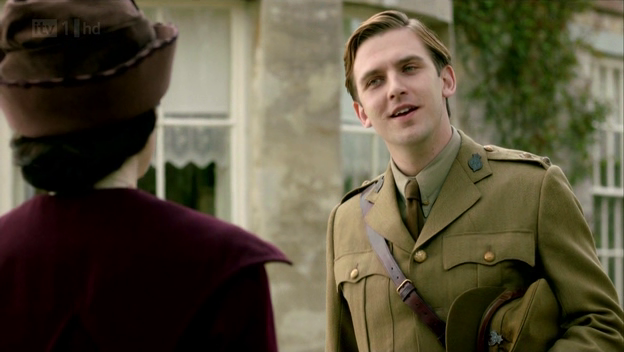
Downton Abbey and the Great War


I'm a long-time Masterpiece Theater watcher -- when you grow up with no cable and only two of the three major networks reliably penetrate the mountain gaps, PBS becomes doubly important as a source of entertainment. Since moving away from home, I probably don't tune in quite as often, which is why I was late catching up to Downton Abbey. I saw enough of last season to get the gist of the main story lines, then tuned in for the premiere last Sunday night. I was even more interested since the story had advanced into the war years, and I have read and studied so much about the literature and history of that era. So while I still enjoyed the soap opera of it, the clothes, and Maggie Smith's one-liners, I did feel a guilty twinge at seeing the Great War trotted out as mere plot device and background scenery.

While I don't expect a popular TV show to turn into a documentary all of a sudden, I do wish the war aspects were handled more subtly and given a bit more gravitas, particularly since this is a British production and not a Hollywood hack job. It probably would have been better to dispense altogether with the trench and Somme battle scenes and not to have stuffed every single Great War cliche into two hours -- while giving nothing its due. The Womens Auxiliary Corps, Land Girls, the White Feather Campaign, Doing Your Bit, Getting a Blighty, Gas Blindness, Shell Shock, the Lost Generation...it's as if every topic from Great War 101 was dutifully introduced and bum-rushed off the stage. If there isn't a soldier-poet's untimely death introduced in the next episode or two I will be astonished!

Well, there I am just being crotchety. So to appease my conscience and balance out all the fluff and nonsense, below is a photo from the Imperial War Museum of London, showing a soldier from the actual Somme battlefield, where there was absolutely nothing romantic or glamorous happening.

The poem below is from Siegfried Sassoon, one of my favorite poets, who survived the war and died the year I was born.

Suicide in the Trenches

I knew a simple soldier boy
Who grinned at life in empty joy,
Slept soundly through the lonesome dark,
And whistled early with the lark.

In winter trenches, cowed and glum
With crumps and lice and lack of rum,
He put a bullet through his brain.
No one spoke of him again.

You snug-faced crowds with kindling eye
Who cheer when soldier lads march by,
Sneak home and pray you'll never know
The hell where youth and laughter go.

- Siegfried Sassoon, Counter-Attack, 1918

[Note: I reproduced the poem above faithfully from my 1918 edition, which may have included original typos -- "snug"/smug, "crumps"/cramps.]


Sunday, January 01, 2012

2012 omen for the New Year?


Every fall and winter I keep my bird feeders full and spend a lot of time on weekends spying on the little visitors -- and squirrels -- and count the birds for Cornell's Project Feeder Watch. This is one of the ways I entertain myself when everything is cold, drab, and brown. But today, sitting on the sofa in the front room of the house, my husband alerted me to an unusual sight -- a hawk settled down on the power line right by our porch at just about eye level. Any time a hawk is in the neighborhood, soaring way overhead, everything heads for cover, no birds, no squirrels, all is quiet. So this young fellow settles down right over our dogwood tree, and we wondered what kind of New Year's omen that could be? He sat for long enough that I scooted away and brought back the camera for the hubby to snap a few pictures.

I am choosing to believe that our hawk visit is something promising for the coming year -- a wild and beautiful creature, momentarily serene and wavering delicately on a wire right before our eyes. Yep, let's go with that.

Here is the Downy Woodpecker who has been hanging out with us lately. And while I'm at it, I might as well add Harry Cat, arch-enemy to birds everywhere, especially tasty nuthatches. (Oh, bad kitty!) Harry lives at my parents' house, so my birds are at least safe from that predator.

Monday, September 05, 2011

Lonesome cowboys

While on my end-of-summer vacation I whipped through Larry McMurtry's Lonesome Dove -- a big, sprawling tale that I missed entirely in its hey-dey; I even managed to miss the mini-series, an omission I'll correct before too long. I had to make myself put it down every now and then to save my eyes. It's the kind of book that has become more and more rare as I grow older -- an honest-to-God page-turner.

I've got a soft spot for westerns and the romance that clings to the idea of the cowboy. My dad's long love-affair with the wide open spaces of Montana is also a draw. I've never been there myself, but I'm fascinated by it because of his travels that started when he was a teenager, old enough to hitchhike out west from Virginia and give my Grandma a conniption, and to cowboy enough to earn his keep on the ranch of some distant relatives for a summer. He kept going back over the years, and the picture is from one of the trips when my Mom went with him, squatting on the sunlit plains in that pretty golden light.

It's a book lovingly written. McMurtry gives his characters space to fill out and take on a life of their own. In some ways they have the stock traits you would expect -- the laconic loner Call, the good-time gambler and womanizer Spoon, and the loquacious dispenser of droll cowboy humor MacRae. There's a full cast of cowboys, Indians, whores, and outlaws, but they all manage to rise out of their stock characters and do surprising, touching, and, often, desperate things.

The basic outline of the story follows the Hat Creek outfit several years after the Civil War. Ex-Texas Rangers Call and MacRae, who have fought the Comanches and Kiowa, and protected the Texas settlers along the Mexican border, have settled down to trade horses and sell cows with a collection of hands, some of them from their Rangering days, which are now over. When their old friend and cohort Spoon arrives running from trouble he caused in Arkansas as a drifting gambler, he shakes them out of their routine of raiding for horses and cattle in Mexic0 with the idea of driving cattle to Montana and claiming the wild land there, which is still harried by the northern tribes and remains mostly unsettled.

The Hat Creek boys light out for Montana, and the perils of the long drive of three-thousand miles serves as the backdrop for the action. Deaths are varied and constant as they traverse the wide open plains, stalked by an array of dangers including bandits, Indians, wild animals and unrelenting weather. There are female characters in this world of men: the unfortunate Lorena Wood, an implacable prostitute who falls in with Spoon on the promise that he will leave the drive along the way and take her to San Francisco, only to be captured by a vicious Indian bandit called Blue Duck; another prostitute, who has married a hapless, small-town sheriff on the trail of Spoon; and independent Clara, MacRae's longtime love, who has married a horse-trader and moved north to the Nebraska plains.

The world that McMurtry creates is one that visits misfortune and terror on both the just and the unjust, but one thing that it often rewards -- at least for awhile -- is competence. Call and MacRae have already built outsize reputations for themselves as Rangers and their abilities have allowed them to reach their golden years, still able to out-fight and out-think anyone who challenges them. Call and MacRae are one of the great literary duos -- as different as two men can be, but tied to each other through mutual loyalty and shared history. It's old-fashioned stuff but I like old-fashioned. And of course, I couldn't read it without thinking of Cormac McCarthy and thinking about where they sort of dovetail and where they diverge with their visions of the west. No doubt, McMurtry stays a little closer to the myth that McCarthy both punctures and extends -- mostly by creating a slightly-altered myth, peering from America's "manifest destiny" record of murder and pillage to an apocalyptic future.

I've often pondered the lives of those first pioneers and all that they faced and endured to stake their claims. The hardships and dangers seem nearly unimaginable to a soft, lily-livered creature like me, but I suppose people have always plunged into things blithely unaware of the reality, and then just had to survive once they were in it. I guess, if I had stumbled into it like that, I'd just be stuck with the situation, which is probably how most people ended up. I may yet see the Bighorn Mountains and the Milk River one day, relying primarily on my competence in avoiding being eaten by a big Grizzly bear. I think I can do it.

Sunday, August 28, 2011

Reading binge


I used to read books like a house afire, especially after I emerged from graduate school and was catching up on all the non-thesis related stuff that I hadn't been able to get to while I was focused on getting my degree -- not that I didn't like what I was working on; I just couldn't decide to take a break and read Grapes of Wrath in the middle of it. It also helped that my first job out of school was as at a bookstore, which is like putting a sugar-fiend in a candy shop.

Then, when I moved on to other employment, I actually slowed down a bit, sometimes for months without even wanting to read anything but newspapers and magazines -- a bit jaded. For the last few months, I've really got back to my roots, which was always 19th century British fiction. And luckily, I've left one extremely prolific author completely untouched, unlike my beloved Austen and Eliot (I have the lone Eliot novel remaining -- Felix Holt -- which will probably fall this winter.)

Right after I began with Trollope's Can You Forgiver Her, I went on to the next door-stopper, Phineas Finn. I was just as hooked with this one. The title character is a young man on the rise. Finn is a poor Irishman, studying law, bored with it, but making fascinating friends in London by way of his good looks, charming manners, and intelligence. His new friends are not only aristocratic, they are politicians and cabinet ministers, who plant the ambition for Finn to also run for Parliament -- a lofty goal for an unknown with no money; in fact, he is still supported by his father -- a modest physician practicing in a country village in Ireland. Finn's plan to run for a seat in the House is met with little enthusiasm, since it means throwing away his law studies (and a more promising professional income in the long run) for the vagaries of serving in an unpaid political post. But so begins the unlikely success of Phineas, who finds himself in the political inner circle of England during the momentous debates around the passage of the Reform Bill of 1867, which sought to extend the ballot to a greater number of men.

Trollope fictionalizes all the real players, but other than changing names, he pretty much hews close to the historical record. And of course, it's not all politics -- there's lots of interpersonal intrigues, romances, doomed marriages, triangles, and even a duel. Also popping up are characters from the first Palliser novel, Plantagenet Palliser and his wife Glencora and, very much on the periphery of this story, is CYFH protagonist Alice Vavasor and John Grey. All in all, more good, old-fashioned entertainment, told with Trollope's customary attention to detail. layered characters, and sparkling wit.

But that's not all!

Just like the infomercials, there's more. I went back to the well on another favorite of mine -- the Brontes. I've read most of the novels except for Charlotte's The Professor and Anne's Agnes Grey, and also Juliet Barker's fabulous family biography. I thought I would try a novelistic version of the Bronte clan, but by an author who I trusted not to make a bodice-heaving botch of it -- Denise Giardina. I loved Giardina's novel about Dietrich Bonhoeffer, Saint's and Villains, which I read back in my bookstore days; plus, she's kind of a home girl, born and raised in the coalfields of West Virginia. She takes as her thorny subject, the least penetrable Bronte in Emily's Ghost, a lovely, moody, smart take on Emily's life and early demise.

Giardina takes what little is known of Emily -- and that mostly from Charlotte's more extensive biographical resources -- and creates a believable version of the semi-mystical creature who has come down to us through the lens of her few poems and that strange, violent, completely original novel, Wuthering Heights. Giardina's Emily is fiercely independent, willful, radical in her politics, loyal to a few, but indifferent to most, and indeed, almost mystically allied with her windswept moors, the voices of the dead, and the animals with whom she feels such strong kinship. She imagines a doomed romance between Emily and the curate William Weightman and creates a very vivid world in which this, perhaps unlikely, relationship could grow. Set against the abject poverty of the people in Haworth Village, the Chartist riots, and the degrading conditions of the now-industrialized mill workers, the concerns of the novel rise above the merely romantic.

I don't want to give much away about how Giardina brings all of it together, but anyone interested in the Brontes should read this novel. The rest of the family is well-represented with Branwell coming off a little better than you might expect, and Charlotte, not very well at all. It's an intriguing portrait and genuinely heartbreaking at the end. The most tantalizing scene for me is the one in which the sister's are sharing their first novels by reading them aloud to one another. Emily's characters and story shocked and dismayed her sisters (which seems probable). Their criticism -- Anne's gentle and Charlotte's much less so -- draws Emily to declare angrily, "But I am Heathcliff -- I am!" It's enough to send me back to read Wuthering Heights again with that in mind. When I think about it from that perspective, it's an idea that makes sense and may even open up the novel to me in ways that I totally didn't appreciate the first time around.

Sunday, July 24, 2011

Trollope...finally

For someone of my tastes in fiction, it's surprising that I've taken so long to get around to Anthony Trollope. Somehow, through an undergraduate English program and then a Master's program that was heavy on British fiction, Trollope was never on the reading list, and I kept filing him away for future reading. Well, finally, after finishing up the delightful Autobiography of Benjamin Franklin, I decided to start with the first novel in one of the two major series that Trollope produced among his 47 novels. For someone so prolific, you need a plan.

Can You Forgive Her is the first of the Palliser novels, so called because one of the major characters figures significantly in all six novels -- the aristocratic and politically powerful Plantagenet Palliser. The major character, however, in CYFH is Alice Vavasor, and she requires forgiveness -- at least according to Trollope -- for her deplorable record in engaging and then jilting suitors. First, her ne'er do well cousin, George Vavasor, then the impossibly well-behaved John Grey, and then back again to George... But Alice is not a flighty, tempestuous, or shallow woman. She is just the opposite -- serious, thoughtful, and sensitive to her own shortcomings and what she owes to the man she will one day call husband.

While she is treated very sympathetically by Trollope, and is charged only with the fault of being overly"self-willed," her real problem is that she is a woman stuck in the limbo of gender roles in Victorian England. On the one hand, she is a sensitive and intelligent woman in the rare position of having a great deal of personal autonomy due to the fact that she commands her own fortune, but still facing an extremely limited array of roles that are considered to be appropriate to a gently bred young woman. She can marry or she can remain a spinster, but there is very little else open to her without an education, and anything but very basic education was certainly not the norm for most women of her time and class. (When Mary Anne Evans (George Eliot) wanted to learn German or Greek, or natural sciences, she either had to engage her own tutors or teach herself.)

With these limited options, the main drama of Alice's life boils down to choosing the "right" husband -- not just someone she can love and respect, but someone through whom she can gain the vicarious satisfaction of having done something meaningful with her life. She can't stand for Parliament herself, of course, so the only political power within her grasp is supporting a husband who has those ambitions.

This is the climate, richly detailed and peopled, by Trollope's imagination. The intrigues of love and marriage are mirrored in the world of politics, and there is just as much treachery, falsehood, pride, and ambition at play in the one as in the other.

Can You Forgive Her is a sprawling, 900-page novel in the true Victorian fashion, in which numerous characters, both major and minor, are fleshed out in full. I often wanted to throttle one or more of the protagonists for their stubbornness, selfishness, coldness, or downright villainy, but they were never boring.

One added pleasure of this novel was reading Trollope's witty description of a meeting of Parliament in light of the current machinations of Congress "negotiating" the debt crisis, and on the opposite side of the Atlantic, the agonizing histrionics surrounding the Rupert Murdoch scandal. Here is a snippet without further comment:

There is something very pleasant in the close, bosom friendship, and bitter, uncompromising animosity, of these human gods,—of these human beings who would be gods were they not shorn so short of their divinity in that matter of immortality. If it were so arranged that the same persons were always friends, and the same persons were always enemies, as used to be the case among the dear old heathen gods and goddesses;—if Parliament were an Olympus in which Juno and Venus never kissed, the thing would not be nearly so interesting. But in this Olympus partners are changed, the divine bosom, now rabid with hatred against some opposing deity, suddenly becomes replete with love towards its late enemy, and exciting changes occur which give to the whole thing all the keen interest of a sensational novel. No doubt this is greatly lessened for those who come too near the scene of action. Members of Parliament, and the friends of Members of Parliament, are apt to teach themselves that it means nothing; that Lord This does not hate Mr That, or think him a traitor to his country, or wish to crucify him; and that Sir John of the Treasury is not much in earnest when he speaks of his noble friend at the "Foreign Office" as a god to whom no other god was ever comparable in honesty, discretion, patriotism, and genius.

Trollope, Anthony (2009-10-04). Can You Forgive Her? (pp. 447-448). Public Domain Books. Kindle Edition.

Tuesday, June 21, 2011

Something wicked this way comes...


The Pilgrims were surely an earnest, long-suffering, and hardened people to have gone through all that they did in planting Plymouth Colony. When it wasn't famine, sickness, terrible weather, or threat of an Indian war enveloping them, it was the more common type of hardships that befell them.

Much of William Bradford's excellent history Of Plymouth Plantation (I'm reading the 2001 edition edited by Samuel Eliot Morison, Borzoi Books) chronicles the business reversals that they suffered, the underhanded dealings of agents who were supposedly negotiating for them back in England with their investors (the Merchant Adventurers), but who were really out to make a buck for themselves. The Pilgrims got the shaft every time they turned around, and ironically enough, had a heck of a time finding a pastor for their flock who wasn't a complete charlatan or who didn't have some peculiar belief that they couldn't countenance. But Bradford became seriously perturbed by the "wickedness" he saw breaking out all around him, just as the colonies were becoming more populous and, at least some, more prosperous.

In his entry for year 1642, he entertains several reasons why all this incontinence, sodomy, and buggery was breaking out like an epidemic. He considers that it is because the Devil has to work extra hard and go to greater lengths to sow corruption in a people simply because they "endeavour to preserve holiness and purity ... and strictly punisheth the contrary when it arises." However, Bradford doesn't like the idea that the Devil is more potent in the New World, so he also reasons that it might be because their community didn't allow sins to "run in a common road of liberty" so when it did break through, it was twice as violent.

But here's where he really lets the Puritan freak flag fly -- it's not because they have more than the normal proportion of "evils" done among them:

But they are here more discovered and seen and made public by due search, inquisition and due punishment; for the churches look narrowly to their members, and the magistrates over all, more strictly than in other places. Besides, here the people are but few in comparison of other places which are full and populous and lie hid, as it were, in a wood or a thicket and many horrible evils by that means are never seen nor known; whereas here they are, as it were, brought into the light and set in the plain field, or rather on a hill, made conspicuous to the view of all. (Chapter XXXII, p. 317)

Ah! Here it is, the forerunner of modern "social networking" but without all the spying and legwork. Now, you can simply out yourself, disposing of the bother of relying on others to do it for you. That, my friends, is progress. And if broadcasting all your evils isn't enough, you can take a picture of yourself engaging in said evils and confirm them. Although, I have to say, if hanging were the probable outcome, modern social networkers might manage to be more prudent. Not that I think that's an appropriate antidote. But as Bradford would say, "Thus much for the present."

All joshing aside, what really strikes me about the passage above and of the whole book, really, is the most earnest, genuine, soul-shaking belief that the Devil is REAL. Not some cartoon red imp with a cloven hoof and pitchfork, but a destructive, preying, malevolent presence haunting your every thought, step, and nightmare. And if you were already of this persuasion in Europe, amongst the familiar rolling hills or grand cathedrals of the cities, how much would that feeling be intensified, in almost perfect isolation, facing an endless wilderness that contained unfathomable threats and mysteries?

It's easy to make Puritans the butt of jokes with our 21st century sensibilities. I know I've certainly done it. But for them it was a deadly serious business; they weren't being ironic; they weren't trying to sell people a bogus story in order to defraud them (well, maybe a few). The belief that they were constantly in peril and threatened by eternal damnation is what they staked their lives on and what made them quite willing to execute those members of the community who might be "infected" by evil, a belief that reached its ultimate expression in the witch hunt hysteria which was to follow.

Sunday, June 19, 2011

Old World, New World


For most of the spring I was distracted by getting ready for my first trip to Paris for nine days in May. Not really being a world traveler, it was a big deal to finally visit a city that has so long figured in my reading, whether history, fiction, or poetry. I've long considered to myself to be more Anglophile than Francophile, though the latter had been increasing in its power as I've probably read more French literature in the last 10-15 years than I ever had before -- Hugo, Flaubert, Colette, Zola, not to mention, all the ex-pat writers who lived in Paris, especially in the 20s.

My husband and I had a successful first trip to Paris -- I say first, because I do hope to make it back again one day. We spent all nine days and nights in the city, walking the streets and boulevards, riding the metro, and climbing stairs -- stairs up to the heights of the Notre Dame towers and the platform of the Arc de Triomphe, and down into the crypts of the Pantheon and to the narrow streets winding from the hill of Montmartre.

We saw the usual sites that tourists visit, cafes and monuments and crowded museums. I walked down the staircase of the Conciergerie where many a victim of the guillotine took their final steps, including Robespierre, whose descent was commemorated on a brass plaque. We stuck our heads into the bell tower where the fictional Quasimodo swung from perch to perch. We were gently accosted on the street by an old lady who was genuinely in a tizzy over the case of Strauss-Kahn, which was just hitting the news as we arrived. I'm afraid we weren't of much comfort to her and said our bon soirs and moved on. We saw Guy Marchand crooning in a jazz club while we ate foie gras and chicken across from a table that included a tiny and well-behaved poodle. We ventured a bit out of "museum" Paris to the 20th arrondissement and saw an indie band favorite of mine in a hole-in-the-wall club filled with hipsters.

People keep asking me what my favorite thing was and it's actually been pretty easy to answer. I love Paris at night, walking along the Seine and over the bridges, especially around the Ile de la Cite and the Cathedral of Notre Dame, lit up and looming over St. Michel. While hardly empty, at night you can tune out the bustle of tourists and street traffic a little more and just look into the river and feel the breeze ruffling your hair. This is when I felt I was really in the Paris of my imagination. I could have wandered around half the night, but we would eventually stumble back to our hotel in Montparnasse after midnight and start again in another part of the city the next day.

So that was lovely Paris, which I'm still processing like a good Romantic -- emotion recollected in tranquility. I'm not a very "in the moment" kind of person; pretty much the opposite. I do all my sorting out of experience, much, much later. And so, far from digging into more francophilia and French literature, I'm on to my next thing, which is...the New World. My world. America.

Wherein I declare John Smith to be awesome

I'm all the way back to the beginnings at Jamestown and Plymouth Colony. I've been reading Captain John Smith, who has to be one of the most fascinating characters in history. I think he lived about nine lives' worth of adventures and near-executions and shipwrecks and disappointments. I find his prose (not at all modernized in my edition, thankfully) a little difficult to follow sometimes. He assumes a lot of knowledge, and then rattles off Indian names and places and I get thoroughly lost trying to figure whose skulduggery he is describing and why his compatriots are always trying to cross him, if not hang him from the nearest branch. He spends a lot of time in his General History explaining, haranguing, and practically begging potential English investors to mount a proper colonization effort -- going in for the long-haul and not the easy money. Forget the gold mines, he says, there's money in timber, cod, and crops -- all there for the taking, which apparently, just didn't sound sexy enough for most people, particularly when the natives are known for flaying you alive and roasting your innards. But as the Captain opined, "It is not a worke for every one to plant a Colonie; but when a house is built, it is no hard matter to dwell in it." You can feel his frustration bleeding out in most of his writings at the lazy, unimaginative, lily-livered mortals he was often trying to prod into action. This is perhaps why they were always trying to hang him, why he finally got kicked out of the colonies, and why the Pilgrims passed on him in favor of the more manageable Miles Standish. This last bit I learned from Nathaniel Philbrick's Mayflower, which I'm reading alongside William Bradford's Of Plymouth Plantation. Bradford is wonderfully crisp and engaging, and I'll probably have more to say about him in a future post. Possibly, he is not as awesome as Smith, but as your Puritan forefathers go, he's pretty snazzy.

Monday, April 18, 2011

Savage Beauty: A Life of Edna St. Vincent Millay

My candle burns at both ends;
It will not last the night;
But, ah, my foes and oh, my friends--
It gives a lovely light!
(First Fig by EVM)
This biography by Nancy Milford has been on my shelf a long while. I'm sure I read reviews of it and put it on my list when it came out, and then one of my writing gods, John Crowley, wrote tantalizingly about it on his blog, so I bought a copy on one of my next bookstore trips. I spent a good part of this March and early April finally reading it, and oh, what a page turner! I love a good literary biography, and I've particularly enjoyed those about my favorite women authors.

Some of my favorite biographers are Hermione Lee who wrote about Virginia Woolf, Willa Cather, and Edith Wharton -- all very smart and well done; the late Julia Briggs also wrote a life of Woolf that I liked very much; Jan Marsh's Christina Rossetti and Juliet Barker's The Brontes are standouts.

First of all, I always thought Edna St. Vincent Millay was a grand name for a poet, and I love lyric poetry of her type and her era. But really, I didn't know that much about her life. I suppose I imagined one of those faintly patrician New England families who sent their daughters to schools like Vassar in the 2os. I was quite wrong about at least one of those assumptions. She went to Vassar alright, but as a "special case" with money drummed up by an interested benefactor on the strength of the poetry she had already written as a young woman and published.

Born in rural, coastal Maine, Millay and her two sisters were daughters of a single mother -- the imposing Cora Buzzell Millay, who had sent her ne'er-do-well husband packing (he is a very pathetic figure in the biography) when the girls were very young, despite the fact that they were quite impoverished and existed very much at the margins of society, where only helpful family members and her own employment kept them with a roof over their head and food to eat. My sympathy was won when reading about how the very young Edna had to keep house and take care of her sisters when her mother was working as a nurse in remote locations -- often for weeks, if not months at a time. It was Edna who had to buy and ration the food that was bought from the money sent home by their mother; who kept the girls groomed and dressed; who made sure everyone went to school and did their homework -- not the most poetic existence in the world. But that is part of what makes her story so extraordinary.

Milford's book is really masterful. Not only does she write well and lucidly, the research is impeccable. While I'm always impressed with how the best biographers can create a vivid life of someone long gone -- except for the written records left behind (often scant and of some far more secretive subjects than others), one of the joys of this book are the little vignettes that Milford includes of her conversations (and negotiations) with Edna's only living sister, Norma Millay, the keeper of the flame, and the gatekeeper of all things to which one might want to gain access if one were writing a biography. Norma died in 1986 and the biography was published in 2001, so that gives some idea of how long Milford was at work on her subject.

Norma seems somewhat Sphinx-like, careful of her sister's reputation, devoted, but also sly, hinting at just enough to lead a scholar on, but then slamming the door shut knowingly and playfully, just when too much might be revealed. For example, she tells Milford some of the things that she destroyed, including one "indiscreet" letter and also some film, pornographic in nature, if she is to be believed (and it's certainly no stretch, considering all the rest of the evidence for Edna's adventurous sexual life) of Edna and her husband Eugen -- home movies, if you will.

There's also something faintly creepy about Norma. Here's one bit Milford includes, in which Norma is showing her some relics from their girlhood:
"But look what Mother made for us," Norma said, as she lifted out of a trunk three identical porcelain-faced dolls -- identical except for their hair. One was dark, and one was blond, and one was fiery red. Norma asked me if I wanted to hold them, and I didn't. They seemed to me spooky, lying in their old muslin clothes, but their hair was real, all right, and richly colored, and dead.

When I said that I found the dolls macabre, Norma thought I meant dirty. "No, Nancy, the hair was washed. Mother washed our hair before she used it." Here was some fragment of their real bodies and Norma wanted me to touch them as she fondled their hair, as if they were relics. I recoiled from them as if they were tiny pieces of flesh.
Just a whiff of the Gothic there, yes?

Edna was a rock star in her day -- back when poets could still have that kind of impression on the popular mind -- she did extensive reading tours at the height of her fame, including my burg of Louisville, KY (of which I'm sure the local newspaper records are readily available -- I just need to dig them out), where she packed the houses and left reporters rather breathless in their wonderment at her voice, her theatrical style of reading, her flaming red hair, and romantic gowns. It must have been quite something to see. She was the New Woman -- a modern, outspoken, fully emancipated woman, and artist, who drove both sexes equally to distraction, and took advantage of every conquest.

Marriage didn't stop the love affairs, and one of the many fascinating aspects of her life, is the way her husband Eugen fitted himself to Edna's needs. At first he seems like the subservient nursemaid, always guarding her fragile health and time, providing her comforts (thought not necessarily the money for them), her opportunities for extracurricular activities, and then it all takes a turn in later years, when he is feeding her addictions (albeit with the best intentions) and isolating her almost exclusively to himself -- a source of great conflict for Norma and the younger sister, Kathleen.

Rather than re-tell the entire life here in a blog post, I wholeheartedly recommend that you acquire the biography, which to me, reads like a good novel anyway. And, in a weird little personal anecdote of my own, I'll close with how, when I was burrowing through my bookshelves, I found my first editions of some of Millay's poetry -- collected when I was still in graduate school, although Millay wasn't part of my studies at all. At the same time I also collected some other poetry of that era, including a complete Robert Graves (who was part of my research). Idly flipping open the flyleaf of Graves, I found it inscribed by none other than William Rose Benet -- brother of Stephen Vincent, husband of the poet Elinor Wylie, both of whom were close friends of Edna's. The book had been in William's possession -- it had his address on a little bookplate in the corner, in addition to his signature. I had never once took any notice of it before, but the name rang a bell this time because I had just been reading about him in Milford's book. Weird, eh?

So I'm not sure what I'm on to next. Poetry now calls my attention, but maybe something completely different, too. It's about time for a science break. I'm thinking about turning my brain to goo with some physics by Brian Greene. Has anyone read The Elegant Universe?

Tuesday, March 15, 2011

Hunchback

I can't quite get away from Paris in my reading -- now that I have a trip actually planned and on the calendar, I've been rather obsessed with the city. I read Hugo's Les Miserables years ago, so decided next to read Notre Dame de Paris, better known stateside as The Hunchback of Notre Dame. Of course, everyone is familiar with the basic strokes of the story, but finally reading it for myself, I was struck by how much Notre Dame, and all the ideas it represents for Hugo, is, in fact, the main character of the novel. And as relentlessly tragic as the story is, the one uplifting thing about it is that the magnificent cathedral still stands. Hugo might have decried its degraded state after the Revolution (and the rest of Paris's "new" architecture), but the fact that it has been preserved -- and I can go climb up into its towers this spring -- is pretty amazing.

Much like Melville's lengthy excursions from the plot of Moby Dick, Hugo indulges in long passages about the history of Notre Dame, the geography of the city, and the arcana of the hermetic knowledge ostensibly sealed up in the very stones of the city's buildings. I enjoyed these excursions much more than I did the detailed description of everything you never wanted to know about the sperm whale industry in the nineteenth century; in fact, the long chapters of Book III, divided into "Notre Dame" and "A Birds-eye View of Paris," are probably my favorite parts of the book.

Notre-Dame de Paris is a particularly curious specimen of this variety. Every face every stone, of the venerable structure is a page not only of the history of the country but also of the history of art and science....One might believe that there were six centuries between the doorway and those pillars. Alchemists themselves find in the symbols of the main entrance a satisfactory compendium of their science, of which the church of St.-Jacques-de-la-Boucherie was so complete a hieroglyphic....This central and fertile church is a sort of chimera among the ancient churches of Paris; it has the head of one, the limbs of another, the trunk of a third, and something of them all. (Modern Library ed., Catherine Liu transl.)
Hugo breathes life into the medieval city and peoples it with characters that seem straight out of Chaucer -- the beautiful and otherworldly gypsy Esmerelda, frightful Quasimodo, ridiculous poet and goat-lover Gringoire, Sack Woman, and the hideously twisted Archdeacon Claude Frollo. One doesn't really feel great affection for any of these characters -- they seem too stylized in their various modes, like figures in a mystery play, but in their pitiable fates, they seem most human. That awful image from the perspective of Quasimodo as he views the hangman sliding down the rope to fall on Esmerelda's frail shoulders is truly sickening (I think I also remember this violent scene in one of the movie versions).

Any time Hugo is describing Quasimodo in the cathedral, the novel really soars -- it is the marriage of the Hunchback to his natural habitat and to his bells that is so moving. And here is the iconic scene of him snatching Esmerelda from her executioners the first time they attempt to hang her as a witch:
Suddenly, when the executioner's assistants were preparing to obey Charmolue's order, he climbed across the balustrade of the gallery, seized the rope with his feet, knees, and hands, glided down the facade like a drop of rain down a pane of glass, ran up to the two men with the swiftness of a cat that has fallen from a roof, knocked both of them to the ground with his enormous fists, and bore off the gypsy on one arm, as a girl would a doll. With one bound he was in the church, holding the young girl up above his head and shouting with a terrific voice, "Sanctuary! Sanctuary!" This was all done with the speed of lightning.

Sunday, January 30, 2011

History lessons

One of my regrets from college is that I neglected to at least minor in History. Instead I mucked around in Business (thinking it would somehow be good for me). Oh, how I rue the time sucked away by Accounting and Economics -- I finally had the good sense to bail on Marketing and leave business admin behind forever. But I also took a bunch of mass comm classes, a smattering of drama, and a couple of upper level history classes, which I thoroughly enjoyed. Had I had a better focus, I could have double-majored in English and History. Of course, this has no practical implications -- I just would have enjoyed the course work more, and maybe had a better grounding for much of my later reading.

As fiction goes, although I enjoy all kinds, nothing beats really fine historical fiction for its power to completely immerse me in another world. I like having very specific moments and places to anchor the author's imaginative work. My favorite writer of the moment is Hilary Mantel. Last winter, I devoured Wolf Hall about the career and life of Thomas Cromwell in the service of Henry VIII, and just recently, I read her novel, A Place of Greater Safety, about the French Revolution and its prime movers and shakers, Robespierre, Desmoulins, and Danton. Of course, there's a lot of "artistic license" that must go into these works of fancy, so I often follow up with a non-fiction counterpart, as when I read Peter Hopkirk's The Great Game after Kipling's Kim.

My only complaint about Mantel is that I find myself a bit deflated when I finish her books -- they are that engrossing for me -- and I dither for a long while on what comes after. Fortunately, my husband made a great recommendation -- going in a completely different direction -- Gary Wills' Pulitzer-winning Lincoln at Gettysburg: The Words that Remade America. I haven't finished it quite yet, but it's excellent. It's not that long ago that I finally read Shaara's Killer Angels and, as luck would have it, even more recently, some classical Greek literature.

One of Wills' primary goals is to refute the notion that Lincoln just jotted down some casual, off-the-top-of-his-head remarks while on the train to the dedication, a notion that has stuck in popular American myth. Wills begins by illustrating how Lincoln structured the Address on the model of classic Greek funeral speeches, most notably that of Pericles of Athens. In following chapters, Wills has traced the most important influences on the speech, including the role of the Victorian "culture of death," the rural cemetery movement, Transcendentalism, and Lincoln's view of the of the primacy of the Declaration of Independence as THE founding document of the United States, rather than the actual Constitution -- the true spirit of the American experiment as compared to the law that was created (with its flaws) out of it. It's completely fascinating.

Here's the text, if you'd like to revisit:

Fourscore and seven years ago our fathers brought forth on this continent a new nation, conceived in liberty and dedicated to the proposition that all men are created equal.

Now we are engaged in a great civil war, testing whether that nation or any nation so conceived and so dedicated can long endure. We are met on a great battlefield of that war. We have come to dedicate a portion of that field as a final resting-place for those who here gave their lives that that nation might live. It is altogether fitting and proper that we should do this.

But, in a larger sense, we cannot dedicate, we cannot consecrate, we cannot hallow this ground. The brave men, living and dead who struggled here have consecrated it far above our poor power to add or detract. The world will little note nor long remember what we say here, but it can never forget what they did here. It is for us the living rather to be dedicated here to the unfinished work which they who fought here have thus far so nobly advanced. It is rather for us to be here dedicated to the great task remaining before us -- that from these honored dead we take increased devotion to that cause for which they gave the last full measure of devotion -- that we here highly resolve that these dead shall not have died in vain, that this nation under God shall have a new birth of freedom, and that government of the people, by the people, for the people shall not perish from the earth.

Saturday, January 01, 2011

Reading fail - The Man Without Qualities

My ambitious book for the winter was going to be Robert Musil's masterpiece, and when I read the first few chapters, I thought it was going to be a success, but at 150 pages or so in, I'm throwing it overboard. I thought it would be one of those rich, expansive, epic stories similar to War and Peace, but...it's no War and Peace.

It has so far been a series of character sketches, and while finely drawn, there just isn't enough interaction, dialogue (but lots of inner monologues), or plot to keep me going -- not for three volumes (never finished!) anyway. I know that it is supposed to be a detailed portrait of the end of the Austro-Hungarian Empire before the Great War and the cultural and intellectual life of the characters, but I just don't have the patience to read about what everyone is "thinking" all the time, without its being tied to some actual feeling. Tolstoy rolls out his characters and they immediately come to life, and he manages to explore ideas and important historical moments while still engaging and entertaining the reader. I'm not really getting that from Musil. So I'm starting my new year by refusing to slog through a Proustian-length novel that isn't going to hold my interest.

Oh well, sometimes you're just not in the mood for certain books. I might be diving into Hilary Mantel's A Place of Greater Safety about the French revolutionaries, especially fitting since I hope to visit France later this year.

Tuesday, November 30, 2010

Backsliding, sort of

I was just looking back over my reading journal, which has slowly gone from an actual physical journal I keep, to being supplemented by this blog, to being almost entirely electronic. I'm not sure I like this transition, but I find it hard enough to keep up even online, plus my reading seems to dwindle more each passing year. For one thing I am reading books that tend to be much longer and denser, and I've had a lot less free time on my hands since this spring, when I started doing music writing on the side.

I spend many evenings doing research, listening to new music, and going to shows and writing reviews. I've seen some pretty cool stuff and got a chance to talk to some musicians that I really admire. It was surreal to chat with Gordon Lightfoot, for example. I've also discovered some great singers and songwriters (for myself, I mean, not "launched their careers") like Joe Pug and Vandaveer. I also enjoyed getting to see and review all of Kentucky Opera's season this year -- I Pagliacci/Cavalleria Rusticana, The Elixir of Love, and Madame Butterfly. Speaking of surreal, I also found myself in the photo pit snapping pictures of Justin Bieber. That was weird. But.. I digress.

I've been meandering through my anthology of classical lit -- I'm only up to Aeschylus -- and although I'm moving pretty slowly, I enjoy it when I get to settle down long enough to read through a section. I definitely would enjoy reading Herodotus more thoroughly, and Pindar's verse. But, I think I'm ready for another novel, and the only question is whether it's going to be something I've had lying around for awhile or embarking on the big winter project of Musil's A Man without Qualities. It may not be time for that one quite yet. I could join my brother in tackling Anna Karenina. Tolstoy always seems right for winter...or I could make myself finish Helprin's Winter's Tale, which I sputtered out on in July. It was obviously not a good match for the season.

This week, however, I'm all about food, so it won't be decided. I'm hosting a holiday party and I spend an inordinate amount of time planning my dishes, my shopping, my prep, and getting all crafty like Martha Stewart (in my dreams).

Monday, November 08, 2010

Reading the classics

On a whim, I read an early John Updike novel called The Centaur, which is partly a retelling of the myth of Chiron, the wise and gentle centaur of Greek myth, who was a a willing sacrifice to the gods to expiate the sin of Prometheus. In the novel, Chiron is high school science teacher George Caldwell, who also coaches the swim team, a lovable loser, convinced of his own inferiority, but devoted to his seventeen-year-old son, Peter. The novel covers three winter days in Pennsylvania in 1947, alternating between Peter's realistic perspective (recalled as an adult) and the third-person prose that weaves the traditional and mythic narrative of the characters and events. In this, as in all of Updike's novels, there is poetry intermixed with the gritty details of the mundane. He describes a gathering winter storm:

The town of white roofs seems a colony of deserted temples; they feather together with distance and go gray, melt. Shale Hill is invisible. A yellownes seeps upward. From the zenith a lavender luminosity hangs pulseless, as if the particular brilliance of the moon and stars had been dissolved and the solution shot through with a low electric voltage. The effect, of tenuous weight, of menace, is exhilarating....Upward countercurrents suspend snow which then with the haste of love flies downward to gravity's embrace; the alternations of density conjure an impression of striding legs stretching upward into infinity. The storm walks. The storm walks but does not move on.
Reminded of how I always loved Greek mythology, and feeling the lack of an actual classical education, in which I would have picked up at least a smattering of Greek or Latin and read some of the great philosophers, I checked out Bernard Knox's Norton Book of Classical Literature to ease my way into some of the ancient writers. I've read Homer and Virgil and some of the plays, but going back into these unfamiliar poems and essays, it's been marvelous to recognize again, how timeless the writing is -- how common the concerns are and how "modern" they sound still, these fragments and scraps from centuries before Christ and Rome's grandeur. I keep coming across little gems that I want to post here, which I'll try to do in the next few days.