Thursday, March 26, 2009

Angels of Destruction


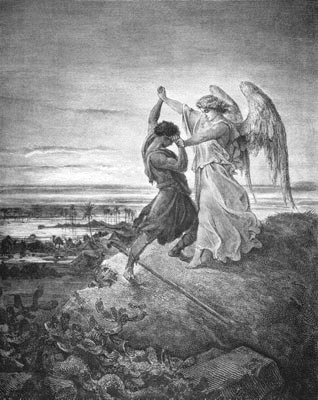
Author Keith Donohue's story gets off to a quick start -- a knock at a lonely old lady's door in the dead of a winter night, a small, threadbare child standing in the cold. The woman is Margaret Quinn, a widow who has never fully recovered from the loss of her own daughter who ran away to join a revolutionary cult -- the Angels of Destruction -- as a teenager a decade before. The strangely knowing nine-year-old is either a runaway herself, or perhaps an angel, born of the woman's prayer to have her own daughter returned. There is a bit of ambiguity introduced as to the role of the girl, who stays with Margaret to be passed off as her grandchild in an elaborate ruse. But the novel definitely favors the supernatural identity of Norah, the waif, who can perform miracles that amaze her fellow third-graders and her best friend, Sean. Another darker, more sinister presence hovers in the background, always watching, insinuating himself among Mrs. Quinn's acquaintances, asking pointed questions about the mysterious Norah Quinn.

There is one brief mention of the name Noriel, which the dark, watching presence inscribes on a snowy windshield early in the novel, suggesting a link with Norah. I did not read up on my angel lore while reading this, but according to esotericaarchives.com, Noriel is the angel of the fourth month, which doesn't really shed any light on the plot, but maybe someone else knows more about this than I do.

Whether you think Donohue pulls off the supernatural part of the story or not, the novel is really about the unambiguously human characters -- awkward, fatherless Sean, lonely Margaret, and her wayward daughter Erica. The themes are familiar ones -- forgiveness, redemption, hope, faith. A novel like this, with one foot in the invisible and supernatural, invites comparison with someone like John Crowley, and it's sure to pale in that comparison. That's not really fair, of course -- it's like comparing every novel about a dysfunctional Southern family with Faulkner or every fishing tale with Moby Dick. My excuse is that I've actually been reading Crowley concurrently. That being said, I think Donohue has written a very engaging story with some minor flaws. I enjoyed it. I wanted to see how he wound it all up in the end, and how the characters fared. Here's a short quote to give you a little flavor of the story:

She was used to moving numbly through the desolation of her life. Like the survivors of momentous devastation, she patched her sorrow and moved on to some semblance of normalcy. And now the girl had come, and Margaret sensed the cracks in her will to abide nothing but the memory of her daughter. Everything, bad as it was, had been fine, bearable. But this morning, Norah had shattered the world.

Monday, March 23, 2009

Choosing one book among the thousands


Oh, what exciting blog posts I come up with. This one is just me thinking out loud about what I'm going to read next, as I just picked up a couple of requests from ye olde library. In addition to the books I have in my home stash just waiting for the right moment, I've also been thinking of going on a tear through the Victorians (again).

From the library, I just picked up a brand new title that I saw reviewed in last week's NYTimes, Angels of Destruction, by Keith Donohue, whom I haven't read before; and also, Brian Hall's novel about Lewis and Clark, I Should Be Extremely Happy in Your Company, mostly on the strength of how much I loved Hall's The Saskiad. I connected with that book in a way that I've done with very few novels. While I wasn't reared in a hippie commune like the protagonist Saskia, I did have the same freedom of movement growing up in the country with lots of time to myself and indulgent parents who just let me lay about reading and fiddling with words. Like her, I was totally immersed in mythology and lived in my imagination, feeling like an outsider most of the time. I thought Hall completely nailed the funny inner life of an awkwardish, teen girl with a balance of humor, seriousness, and poignancy. It's been several years ago that I read it, and I would have to resort to my old-timey, handwritten book journals to fill in more details.

Meanwhile, I've been thinking about Dickens and the Victorians, in general, after reading Eminent Victorians last fall. It's one of my favorite literary periods, home to one in my triumvirate of writer-goddesses, George Eliot (the other two being Austen and Woolf). I've read quite a lot of that company, yet with some rather enormous gaps -- not much Dickens (only A Tale of Two Cities and Great Expectations) and no Trollope at all. So, first on my list is Bleak House, which I was assigned to read way back in a "rise of the English novel" class in college, but skipped out on -- I was just too overwhelmed at the time to plow past that first twenty odd pages about the fog in London. But when I finish it, I can say it took me twenty-five years to read Bleak House!

I really cleared the decks to read War and Peace over the winter and didn't get distracted, but like most serious readers, I always have so many candidates crowding their way to the front! I'm usually interested in about fourteen things at the same time, but I've learned that I don't really enjoy trying to read more than one book at a time. (I might make a teensy exception, since I'm currently re-reading Little, Big.) So, I think I'll try the Donohue, which will go fast if I like it, and might fall off the list if it doesn't grab me; then Hall and finally, Dickens.

And dear God, if you have any other recommendations, don't tell me about them!

(Just kidding.)

Thursday, March 19, 2009

Dream houses

Last night before bed I was reading Crowley's Little, Big. One of the central images in the novel is the mysterious house at Edgewood, which depending on one's approach, has many different front's -- in effect, many different houses in one. They all connect on the inside, a rabbit warren of hallways, doors, stairs, and curious rooms that meet at odd angles. And last night I dreamed first of going down a long, tree-lined avenue and on both sides were all sizes and styles of houses, lining a very green and quintessentially American street. There were painted ladies and shotguns and Cape Cods, but as I was telling my companion in the dream, how strange to find such a street in the middle of desert in Saudi Arabia -- like a mirage!

And then the dream changed slightly and I was on another street with impossible-looking houses, Gothic looking structures and cathedrals, only these buildings were partially buried in the ground, up to their gabled roofs and domes -- one very like the dome of St. Paul's. They were not destroyed or harmed, just built into and underneath the ground, with trees and vegetation all around them, and one knew that they were massive and intact under the earth when you entered inside. I did go in one, and the floors were leaded glass, and you could see the shadowy floors plunging below.

Houses have always been a central image in my dreams ever since I can remember. Houses familiar and completely foreign -- I remember dreaming vividly of a house in Africa, hexagonal or octagonal, with windows from floor to ceiling, set down in a jungle so that I could see the wild outside, the birds and animals and exotic flora curling around the decks. And familiar houses, sometimes even my own, always have secret rooms or entire floors that I've forgotten; they are filled with things I've forgotten, treasures. Doors, attics, secret compartments, winding hallways, and staircases are everywhere in my dreams and whatever I think I'm about to find or could find remains just out of reach and often I can't find my way back in once I've left.

Of course the other thing I read before sleeping was Matthew Arnold's poem, "The Buried Life"; hence, the buried houses, I suppose.

But often, in the world's most crowded streets,
But often, in the din of strife,
There rises an unspeakable desire
After the knowledge of our buried life;
A thirst to spend our fire and restless force
In tracking out our true, original course;
A longing to inquire
Into the mystery of this heart which beats
So wild, so deep in us--to know
Whence our lives come and where they go.

Tuesday, March 17, 2009

Ryan Adams and the Cards

It's kind of funny how you have to approach a Ryan Adams show: Expectation (if he's "on," it has to be great), exasperation (I hope he's not freaking out this time), speculation (will this be the last show before he breaks up the band?). So I actually felt sort of relieved when I got to see a full set, he didn't do anything too weird, and his voice sounded fantastic. Success! I thought the best moment was when he broke loose with "Come Pick Me Up," not just because it's one of my favorites, but because it came pretty early and I thought it signaled a wide-ranging affair from his huge catalog. The only disappointment was that there weren't more rockin' songs like Magick thrown in. I totally agree with Jeffrey Lee Puckett's review that all of the songs were the same tempo -- very mellow. I would have liked more energy. But that feels a little nitpicky considering he really did perform well in that purple light. It wasn't as dark as the last time when he hid under the infamous hoodie, but I only saw the silhouette of Ryan. Man of Mystery.

I did have an insight into the mystery, however. When he finally engaged the audience in a little midset chit-chat and the lights came up just a bit, he said something like, okay, you've scared me enough, you can take the lights back down. And I thought, it's not just an act, he really is uncomfortable performing! Performance anxiety -- possibly debilitating? It kind of fits in with the drugs and alcohol, which might have been his way of controlling it, and now all clean and sober, he has do it differently -- practically in the dark, at a safe distance from the audience. See, speculation. Well, it's one theory. I know that he blames inner ear and hearing problems "on the record" as his reason for the rumored abandonment of music for his literary career. Who knows, but it would be a shame if stops recording, hard as that is to imagine.

Levi Stahl

When John Crowley links to anything on his livejournal page I feel compelled to check it out. That's how I found The Whole Five Feet and now, I'vebeenreadinglately, Levi Stahl's blog. Sometimes when I think I read a LOT, I run across someone who puts me to shame. Or maybe it's not so much that I don't read as much, I just don't read as well, as critically, and as deeply as others do. And I certainly don't write as well about reading. Reading the entries in Levi's blog makes me want to hang up my sad little tappety-tap keys and find a Harlequin romance.

His recent post about Penelope Fitzgerald will motivate me to finally read one or more of her novels. She's been on the radar for a long time, but somehow, I've just never got around to her. I just requested several books from the public library, and I will now have a few more to put on the list. Of course, I just started re-reading Crowley's Little, Big.

Wednesday, March 11, 2009

A Sport and a Pastime

I finished James Salter's novel, title above, having previously read The Light Years. I've heard many people gush about him, particularly other writers, but I have to say, I don't really get it. The writing is good, of course, frequently lovely and I enjoyed his wonderful evocation of the French countryside, describing the seasons, the light, the empty sidewalks and cafes. But the people -- the characters -- I don't connect to at all. He reminds me of Fitzgerald and of Hemingway in the kinds of people he writes about, the floaters on the waves of other people's money, angst-ridden adventurers, the sad, jaded rich, and beautiful virgins/whores that figure as enchantresses and victims and the left-behind. They never seem real to me, and in fact, they just get on my nerves. Is it a class thing? Those vaguely patrician, Ivy-league educated ne'er-do-wells and American women who go abroad to get a title and a villa? It's all just a little too precious for me.

I won't say I hated it, but I read it without much joy. In a better way it reminded me of William Maxwell's The Chateau, but mainly because both stories concern Americans (always cast as innocents -- a well-worn theme) abroad in post-war France, adrift in an alien, if alluring culture. Well, anyway, I think that does me for the Salter experience.

I've been thinking I might re-read (which I don't often do) Little, Big by Crowley. It definitely merits another reading, and I'm sure I'll soak up more the second time. It's so magical and mysterious and suggestive. A review on its 25th anniversary just appeared in the Guardian. He has a new novel in the works -- WWII era, I believe.

Tuesday, March 03, 2009

Holy the Firm

I re-read Holy the Firm by Annie Dillard. An excerpt:

Who shall ascend into the hill of the Lord? or who shall stand in his holy place? There is no one but us. There is no one to send, nor a clean hand, nor a pure heart on the face of the earth, nor in the earth, but only us, a generation comforting ourselves with the notion that we have come at an awkward time, that our innocent fathers are all dead--as if innocence had ever been--and our children busy and troubled, and we ourselves unfit, not yet ready, having each of us chosen wrongly, made a false start, failed, yielded to impulse and the tangled comfort of pleasures, and grown exhausted, unable to seek the thread, weak, and involved. But there is no one but us. There never has been. (Harper and Row, 1977)

She is like Donne to me -- difficult, brilliant, stark, unafraid to plumb the depths and attempt a measure of the heights. She delights and scares the bejesus out of you at the same time. She makes you pick up the dictionary. Pay no attention to anything I write, but read Pilgrim at Tinker Creek or Teaching a Stone to Talk.

Sunday, March 01, 2009

Reading big, important books


I just finished War and Peace today; it took a couple of months, reading at a pretty leisurely pace. As I've already written, I fell in love with it from the beginning, and I didn't change my mind about it. What is amazing is that Tolstoy wrote such a beautiful, sprawling novel seemingly to illustrate his view of history and his critique of the great man theory. The Epilogue dealt mainly with his argument against the traditional view that watershed events -- particularly wars, revolutions, mass migrations -- are driven by heroes like Napoleon and Alexander -- that their will, genius, power-wielding carries the masses to do their bidding. His story, with its many characters, high and low, bad and virtuous, weak and strong, shows that this view is false; that causes and effects are impossibly complicated; that our perspectives are too limited; and it can only be the interacting masses of wills and relationships, along with a mysterious equation of constraints that he calls necessity and freedom, which actually makes "history." There is no way I can quickly boil down what he took about 1200 pages to get at and no guarantee either that I understood it perfectly as he meant it, so I'll leave it at that.

But here's one takeaway that I have from reading another of the Big Important books: it is nearly always the case that they are hyped to be much more dense, unapproachable, and difficult than they really are. Your reading pleasure will be maximized reading W&P if you are a student of history, particularly military history, but you can just as easily chuck all the theories of history and just read it as adventure and romance on a huge scale -- an epic family drama. The only difficulty is keeping the Russian names straight in the beginning, and of course the time commitment if you are a slow reader, but otherwise, it's great fun. I've had exactly the same experience with Crime and Punishment, Moby Dick, and Ulysses, all of which I approached with a sense of intimidation, but which I found to be genuinely entertaining. (Okay, there was a long bit about the sperm whale industry in MD that made me want to poke Melville with a stick, but you can skip that; no one is going to call the lit police.) I was very nearly finished with Ulysses when I finally started to get the "big picture," but there are many charms along the way, even if you suspect you're missing a lot.

You can argue all you want about the dead, white guys dominating literature for so long, but it's not just a conspiracy -- the great books are really pretty great, and you can still enjoy the wonderful diversity of contemporary fiction -- men and women, white and black, the dead and the undead (vampires have had their voices silenced for far too long).

Perhaps, I'll test my theory further one day if I ever read Finnegan's Wake, which has always looked fairly incomprehensible to me. If you've read it, let me know.

Sunday, February 22, 2009

Marah and Brandi Carlile


Dave Bielanko and Marah

I make it a rule to see Marah at every reasonable opportunity, and I'm never disappointed. We were all psyched to see them in their latest formulation (temporarily without Serge, the other Bielanko brother, and with a new drummer and bass player plus Christine, the keyboardist) and arrived at the appointed place...only to find it completely deserted! Refusing to believe it, we got out and saw the sign pinned to the door -- the show was moved to another bar. Every time I've seen them, they've been relegated to a smaller, crummier venue. They really ought to be packing out the Palace or the Waterfront on a summer night. I think it bothers me more than, say, Dave Bielanko, who seems to take it in stride. I think he's genuinely more interested in the music and the experience than achieving wealth and fame, and they never shortchange an audience, no matter how small.

On this night, I was in the middle of an allergy attack, which made me feel miserable, but between a medicinal, near gag-inducing swig of my hubby's bourbon and Marah finally coming on, it magically dissipated. It was a somewhat surreal evening of kick-ass music, a dirty backroom dive, and these crazy-dancing ladies who kept drinking white russians and buying them for the band, prompting Dave to claim, "It tastes just like Christmas morning!" And through all of this, from the time we got there until we left around 2 a.m., some poor dude was sitting on a stool, as completely passed out on the bar as I've ever seen anyone. I never saw him stir, apparently not even when the gals playing foosball adjusted his chair to give themselves more space, or -- needless to say -- while the band ten feet away ripped through, "Coughing up Blood." Someone else needs an intervention.

Well, one good thing about such intimate gatherings is that you actually get to talk with the band if you want to. I had to stick around to buy a new tee, since my only other one from Marah is too small to wear in public. I told Dave how much we always enjoyed the shows and asked him about the new album. He said they were close to finishing it up in Nashville (the next stop) and that he thought Serge would be ready to rejoin them when they toured in April. He and Christine were both very nice, tired, and grateful for kind words. I'm so glad I stayed up past my bedtime.

Brandi Carlile and Sondre Lerche

In the Pops series, the Louisville Orchestra teamed up with Lerche to open and Brandi for the headliner. Lerche is really impressive. Such a youngster, but with lots of poise and a fabulous crooner voice. I think the crowd in Whitney Hall was well-pleased with his performance, since of course, everyone was really there for Brandi. And even though he didn't play guitar with those huge, Norwegian mittens from the PR headshot, I still enjoyed it!

My expectations were high for Brandi, since she's one of my very favorite artists; I actually think she was even better than I thought she'd be. Her voice is phenomenal -- really, really big and strong -- the recording process does not add a thing that's not already there. And if you possibly can, you aspiring leaders-of-the-band, manage to frame yourself with identical twin musicians! I love the harmonies Phil and Tim Hanseroth bring, and of course, the guitar skills. Oh, and I should not forget the barefoot cellist, Matt. She sang new songs from the forthcoming album, which were strong -- "Dreams" and "Oh Dear" -- some from her other records including "The Story" and "Follow", and great covers of "Folsom Prison Blues" and "Hallelujah." She does the best Johnny Cash since Johnny Cash! She's so inspiring. She's the reason I bought a guitar (even though it's currently gathering dust in the corner), and now that I've seen how skinny she is in her second-skin blue jeans, I'm also inspired to get a little more running in. Dang you, Brandi Carlile!

Monday, February 16, 2009

Good stuff

We saw Gary Louris and Mark Olsen last night. My husband and I were both impressed by G.L.'s guitar skills, and I was astounded at how great they sound together live. Like Simon and Garfunkel, theirs are just two voices that blend together beautifully. I was happy to see the bar packed for them (SRO), even though that sort of thing is harder and harder on my back and knees. Orthopedic shoes? I'll just suffer for other people's art, I guess. Lots of Jayhawks' fans there -- all, as they say, "of a certain age."

I just rediscovered Okkervil River after hearing some of "The Stand Ins" -- a sequel of sorts to "The Stage Names," which when I first heard it, didn't grab me at all. I like the other so well, I'm going back now to give it another listen. Also, I'm still fascinated by Antony and the Johnsons (they have a new CD out); I first heard Antony on the Leonard Cohen tribute, "I'm Your Man," and I've been checking him out since then. I still haven't bought anything, but I'm still trolling through some of the songs, trying to figure out what I'd like best. He definitely has a different sound going on, but I like it -- there's something a bit otherworldly in his music, but you wouldn't want to dance to it, unless you're dancing over someone's grave maybe.

I've embarked on the fourth and final volume of War and Peace, which has vaulted into my favorite novels of all time very easily. As lengthy as it is, or maybe because of it, I'll be sad to finish it. If I'm stranded on a desert island some day, and the smoke monster isn't coming for me (Lost -- I'm in too deep to stop now), I'd like to have a copy of W&P with me.

Monday, February 09, 2009

On crap

I generally stay away from commenting on things that I don't like. Rants can be very tiresome and there's no end of things to deprecate, whereas there's so little that approaches sublimity. One should be more selective. However, having subjected myself to a weekend of UTTER crap, I feel compelled to flush it out of my system. I wanted to call this post On Bullshit, but it's been taken, of course.

I'll start with the movie Beowulf, starring a high-profile cast of actors who might have thought they would be less embarrassed as CGI "enhanced" versions of themselves in this stinker. My husband called it, jokingly, clay-mation. Other than stealing some of the same names and general setting, this Beowulf bears more resemblance to the Grand Theft Auto video franchise than the epic, Old English poem. Why not just make your movie without attempting to reference the original, if nothing about it suits you? It's as if the screenwriters were still so ticked about having to read it for their British Lit survey, they decided to give it a good, old-fashioned Hollywood fucking-over just for spite. Please! Blame the teachers, not the poetry.

The movie was both gross and inappropriately funny as when nude, faux-Beowulf's manly bits kept getting the Austin Powers sight-gag treatment. Helmets, chandeliers, roof beams all kept getting in the way of the "camera." Naked Beowulf slithering all over Grendel's mucousy backside was just inspired...but by what I don't know and don't wish to know. And instead of a shaggy, swamp beast, insert Angelina Jolie with weird, barefoot stilletto-heels. Now that's some monster! Oh, it was just so very awful and juvenile in it's presentation that it seemed downright mean-spirited. My husband had the good sense to fall asleep -- at least until I poked him and made him sit up.

Sadly, a moody, artistic, elegiac movie version of Beowulf could be made with the right spirit and creative people involved. I thought of something like Julie Taymor's Titus, which also starred Anthony Hopkins (the unfortunate Hrothgar here). A throbbing score, beautiful Scandinavian vistas, and dialogue studded with that wonderful Old English cadence would be something to see. But instead, crap. Utter crap, even.

The Grammy's

Thankfully, I was reading War and Peace while this was going on, which is kind of like viewing an eclipse through a pinhole -- you won't risk permanent blindness. It was one trainwreck performance after another, with only a few exceptions. Strangely, everyone seemed better dressed than usual. You should at least be able to count on the Grammy's for some really tacky getups.

The benighted idea of pairing classic acts with newcomers served neither well. The greats seemed desperate and sad, while the newbies were just plain bad in comparison. Stevie Wonder with the Jonas Brothers? Ouch. And what about trotting out the only surviving member of the Four Tops? More pain. Which brings me to a few points about Katy Perry, bless her. Some of it really wasn't her fault, because I assume she wasn't responsible for the "production" components.

First, if one is going to be vamping while surrounded by giant fruit, at least go with the sexy kind -- pomegranates, figs, juicy mangoes. At any moment I expected to see the Fruit of the Loom guys popping out from behind an apple. And they might have busted better moves than Perry, which leads me to the second point. Sign that girl up for Madonna's dance camp! Of course, she probably felt justifiably ridiculous having just descended from a giant banana. And from all the hoopla about this song, you would think she invented lesbians, or lipstick lesbians, or even lipstick. I'm bemused since Jill Sobule was the first woman to sing a song titled -- gasp!-- "I kissed a girl" way back in the pre-Twitter era of 1995, while Perry was still going to Vacation Bible School. All of which is not really a knock on Katy Perry herself, who seems clever and is trying to make the most out of what may only turn out to be 15 minutes of fame.

So, there's really no moral here, other than that I find crap disturbing. I just needed to get that out of my system.

Tuesday, February 03, 2009

In the grip of winter, distractions must be found

The snow and ice did not quite melt away before the chill set in anew -- today, a brisk wind blew clouds of snow off the rooftops of the office buildings producing, for a few moments, a faux blizzard. Real snow fell this morning, but didn't last, and it's rather bitterly cold, refreezing the old snow and ice. I wrestled the wheeled trashcan to the curb this morning, up and over the ridges of snow and found a cove between shoveled mounds to perch it near the curb. Everything becomes difficult -- routine chores, walking, driving, concentrating on work.

Companionably, London was hit by a snowstorm that brought the city to a halt, and the citizenry is none too happy about it. School closings! One quote in the Guardian was someone bemoaning the officials' unpreparedness and remarking that a bad example was being set for children, who were being taught that when things get difficult, just stay home and have fun. If that person were transported to the U.S. and could observe our love and acceptance of snow days, he might wonder afresh how it is that we became the most powerful nation on earth.

And in yet another example of American sloth compared to the British -- we who choose a mere 25 or 50 or at most 100 "best novel" lists from time to time -- the Guardian newspaper has compiled a list of 1000 novels "everyone must read." Now seriously, Americans don't even want to read a list that long, much less the actual novels! I feel certain that I can die without regret, if die I must, not having read John Grisham's A Time to Kill, or even anything of Martin Amis. Of course, those Guardian folk are probably indulging in some good-natured hyperbole with the "must read" directive, particularly when one of their own, the lamentable Victoria Beckham (aka Posh Spice), infamously claimed never to have read a single book. I thought every English person was born clutching a copy of Bleak House.

And finally, my browsing uncovered another tribute to John Updike by one of my very favorite writers, Ian McEwan, summing up thusly:

The Updike opus is so vast, so varied and rich, that we will not have its full measure for years to come. We have lived with the expectation of his new novel or story or essay so long, all our lives, that it does not seem possible that this flow of invention should suddenly cease. We are truly bereft, that this reticent, kindly man with the ferocious work ethic and superhuman facility will write for us no more.
Music
Under the banner of welcome distractions, it seems as if the music world is conspiring to send all my favorites to town in the next two months. I already was planning to see Gary Louris and Marc Olsen, Brandi Carlile, and Ryan Adams. Today, I see that Marah is also stopping over this month, and the Cowboy Junkies are playing a gig with the Louisville Orchestra in March. I need to win some radio tickets or I'll go broke. I did find one freebie last night -- the Von Bondies' (also touring, but not nearby) new song, "Pale Bride." He may be Jack White's sworn enemy, but I like Jason Stollsteimer's voice a lot; the VBs certainly have a lot of attitude live. It's still one of my favorite rock shows. I'm sure the small venue had something to do with it. I thought they'd disbanded, it's been so long since I heard anything out of them.

Saturday, January 31, 2009

Ice Storm


Suffering through a snow and ice storm is inconvenient at best and often very dangerous, as we Kentuckians are finding out. However, aesthetically speaking, it is a wondrous thing to behold, particularly if you don't have a tree knifing through your roof and you're not freezing to death. For a day before the snow turned to ice, the birds in my backyard were obviously fueling up. All day, cardinals, house finches, juncos, and sparrows clustered around the feeders. My goldfinch feeder, full of nyjer thistle seed, usually lasts weeks. It was drained within a day and a half. Everytime I looked outside three or four would be fighting over the two perches on the tube. In the picture, two of them sit on the fence, waiting their turn, flanked by house sparrows.

A dead, brown landscape transformed overnight into a glittering, crystalline world, and the birds disappeared. Individual magnolia leaves, coppery-brown, suspend in their own glass boxes like bees caught in amber, but perfectly clear, every vein visible. A heavily beaded dogwood stands against a Wedgewood blue sky, bare barberry hedges drip with diamonds, the holly leaf's sharp points grow into claws of ice. Every surface is brilliant with refracted light and icicles lengthen into daggers and spears, dripping off every roof and gable. The first night of the storm, at 2:30 in the morning, I awakened to the first crash of limbs falling in the neighbor's yard. All night and into the next day you could stand on the porch and listen to cracking, groaning branches giving way and exploding into the surface of ice-crusted snow as if a giant beast was lumbering though a forest.

Today, it is sunny and clear, and the melting has begun. There is a continual drip, slide, crash, and sizzle. Maybe the birds will venture back out from their hiding places.

Wednesday, January 28, 2009

John Updike, RIP


In that category of public figures that you don't really know, but care about, I always find it particularly sad to say goodbye to writers. Their work, which has been such a pleasure and an education, is at an end. We can only re-read and savor what's left behind -- which is invaluable -- but never will there be anything new.

Even though Updike has never been one of my most-loved authors, he has always been a writer that I have admired for his lovingly crafted and poetic sentences and for an old-school, writerly work ethic. He's always seemed a throwback to writers like Dickens and Trollope in sheer volume, and like those other giants of Victorian letters -- the combined novelist, essayist, and critic who seemed to know everything and be capable of illuminating any subject.

I've read Rabbit, Run and Rabbit Redux, and a smattering of essays and short stories, but personally, I like him best for Gertrude and Claudius. It takes a certain renegade quality and degree of confidence to take on something as canonical as Shakespeare's Hamlet and transform that story, without doing damage to the original, to something uniquely your own. And, of course, he will always remain memorable to me for the book that I started and couldn't finish. It was probably not a good choice, since I was bound to compare it with Garcia Marquez, but Brazil was a book that I could put down. However, his vivid comparison of yams to a certain part of the male anatomy has stuck in my mind. And the fact that I have never walked through the produce section quite the same person says something about the power of the image and the writer who created it.

Thursday, January 15, 2009

Austerlitz and after


I just finished Volume 1 and am well launched into Volume 2 of War and Peace. The last bit of V1 was Tolstoy's version of the Battle of Austerlitz. And apparently, it's not just we southern Americans who can't stop fighting wars long gone and lost. Courtesy of the BBC, the picture accompanying this post is a somewhat recent re-enactment of said battle.

I'm very taken with W&P. The characters are marvelous and, although I knew it was set during the Napoleonic wars, I don't think I realized how much of it would be based on the history of those actions. It's always interesting to figure out how writers decide where history and fiction part ways. For example, one of the "characters" is General Kutuzov -- a real person, but I'm assuming the young adjutant Prince Andrei is Tolstoy's creation. I love it. I've always been interested in the Napoleonic wars, but mainly Napoleon's dueling with Wellington, so this earlier part is educational.

I read with nerdly relish the battle scenes and try to imagine how it must have looked. I learned to love battle maps for that reason. I'm not very good with maps, but even I, after staring at them long enough, and reading the descriptions can finally begin to see how the geography shaped the action. I first had this breakthrough when reading WWII accounts of the ground war in the Philippines. Suddenly, some of what I read started to make more sense.

And speaking of maps, I like the way Tolstoy treats the drawing rooms and dining rooms of Russian society in the same way he sets the stage for the war scenes. He's always careful to say exactly where everyone is sitting or standing in relation to one another, and he tracks their movements and conversations with the same careful attention to detail. There are as many schemers, glory-seekers, and adversaries in these settings as on the fields in Austria. There's Anna Mikhailovna with the heavy artillery, Prince Vassily with the feint, and there's poor, blundering Bezukhov in full retreat. I should try to sketch one of those out! One of my favorite scenes has been the deathbed struggle over securing old Count Bezukhov's will before he finally croaks. It's deliciously funny. Well, maybe it isn't supposed to be...but it is. Thankfully, I've managed not to find out too much about this novel -- I suppose people don't find it easy to sum up such a plot and cavalcade of characters, and I've never seen the movie versions. I know Henry Fonda played Pierre Bezukhov but I'm seeing someone who looks a lot more like Oliver Platt or even P. Seymour Hoffman. He needs to be more rumpled and portly (at least, thus far).

On another track entirely, a much shorter and amusing read is John Crowley's latest blog post about his recent run-in with the law.

Monday, January 05, 2009

War and Peace 2009

I've finally decided to tackle Leo Tolstoy's classic. I read The Kreutzer Sonata and The Death of Ivan Ilyich a while back and liked them both. So, for the foreseeable future, if anyone ventures to ask me what I'm reading, then the answer is going to remain the same.

I've also just started listening to the new album (I still call it an album, even though I downloaded the MP3s from iTunes) by Kasey Chambers and her husband, Shane Nicholson, Rattlin Bones. It's one of those rare ones that you love from the first listen and every song is a keeper. Their voices are really beautiful together -- I'm a sucker for a good duet. But it's more than just duets -- it's two people really singing songs together. You don't think of Jack White and Brendan Benson doing duets, for example, or Steven Page and Ed Robertson. The collaboration is a little more involved than that -- from the songwriting to the instrumentation. Anyway, it just made my "best" list of 2008 (I think it was released in September). In no particular order, here are my other favorites from last year:
  • Cardinology, Ryan Adams and the Cardinals
  • Acid Tongue, Jenny Lewis and peeps
  • Fleet Foxes, Fleet Foxes
  • Evil Urges, My Morning Jacket
  • Consolers of the Lonely, The Raconteurs
  • Angels of Destruction, Marah
  • Vagabonds, Gary Louris
Coming up, I hope to see Brandi Carlile, Louris, and Adams in the next few months, and I'll keep my fingers crossed that the latest incarnation of Marah, comes around sometime this year. I just read at Kelly Willis' site that after a few April shows, she is on extended hiatus from the road, having found that four small children and a tour bus don't really mix. I can't imagine how it could, since her husband is also a musician.

Tuesday, December 16, 2008

Lameness

It's as good a theme as any at this holiday season. Everything seems to have come up short -- shopping, decorating, cooking...and books. I was reading Cloud Atlas, which I never did grow to love. I read half way and decided life was too short, and in my humble opinion (no, I'm not using the texty shorthand), it did not deserve the Booker Prize. Overly clever, if not pretentious, no heart, which isn't the same as having no talent. I skipped-read through the latter half and decided I did myself a favor. The profound thesis at the end -- something about the human race being rotten at bottom, or maybe it was inherently good, whichever way he ended up, was -- you guessed it -- lame. It seemed so unimportant, I've forgotten. I'm being harsh. Much better-read people than me thought it was marvelous, I guess. As noted, Chabon said he loved it (or cleverly disguised that he did not) on the book jacket blurb.

So, I haven't started anything else. I have Reservation Road, which someone described as "the bleakest" American novel ever written. Probably not, but I'll save it for the beach anyway. Meanwhile, I read some of Davis McComb's second book of poems, Dismal Rock, and still love him. Ultima Thule was beautiful and I still go back and read those poems. For such a wonderful poet, he seemed strangely well-adjusted and nice when I met him at a book signing. He signed my favorite poem in Ultima, "The River Under the River."

...Tonight the river is at work dissolving, solving
over and over the riddle of its loosening.
I want to know how to hear it, and what it might teach me:
how to inhabit this thing of bone, gut, and blood,
this part of me that would not vanish if I vanished.

Wednesday, December 03, 2008

Winter days


I went for a walk today during lunchtime -- my usual laps around the old manse property, marooned in the midst of an office "park." On the way back I cross the divided four-lane to the pond and see what's going on over there. It wasn't that cold, 40s, a little gusty. The longer I stay out, the better it feels, and I don't really want to go back to the office. The leaves have flown and all of the color has faded, but winter has its own melancholy charms.

Today, I noticed the muted shades of December without snow. The clouds were thick and layered like blankets, the color of slate, iron, and new bruises, pushed down over watery blue patches of sky. The ground is marbled green and brown and covered with the little wooly heads left over from fall aster blossoms. Doves settle down in the willow branches and a little flock of dark juncos flit in the undergrowth by the pond -- winter birds themselves with little frock coats of dark black and soft gray. Geese sit on the pond and a ring of ducks circle in the middle, dabbling, and seemingly chasing each other's tailfeathers. The water is lapped in the wind, blue-black to the white rocks on shore. Windblown branches are everywhere and among them, the bare, scarlet stems of a brambly shrub. I think I looked it up once and have forgotten again what it is. They are beautiful in winter -- as bright as male cardinals.

I spent November in Donne territory, appropriately enough. I finished the Stubbs biography, which took me most of the month. It was very good and I think it definitely gives me a better context for the poetry. I'm reading David Mitchell's Cloud Atlas. I'm only into the fourth section (story?), and it strikes me as a bit of showing off. "Now I shall write in the style of a nineteenth-century English adventurer and now in the style of a rather louche 1930's man-on-the-make," etc., etc. It would be more fun if it were Michael Chabon (who plugs it on the back cover); still, it's well done, and I may grow to love it.

I made peanut-butter fudge -- one of my white whales of cookery. Okay texture, but not peanut-buttery enough. I have another recipe to try still. I'm going to bake cookies, as usual. And I unearthed my mother-in-law's old cookie cutters -- some of which I'm sure my mom also has somewhere. Not an old one, but I found a camel-shaped cutter in the stash. I love camels! I'm going to do a little Christmas decorating by the end of the week. I'm auditioning tree alternatives.

Monday, October 27, 2008

I should blog more often


I seem to be on the once-a-month schedule, which for "bloggers" should be more like once a day. Glad I'm not one of those!

After reading Stevenson, I couldn't really settle on anything. I tried a novel that I had heard about recently, concerning Darwin, called Mr. Darwin's Shooter. It actually seemed promising, but there was something about it that I just wasn't in the mood for in between the time that I requested it and when I actually picked it up at the library, so back it went.

I decided to go with one of Crowley's early novellas called The Deep, which was published back in 1975. It was really interesting to see the development of his style and themes from early work to the most recent. It was a very dense, challenging story to follow -- I think it's the disorientation of not quite knowing what world you're in. There are very familiar elements of historical fiction, except the medieval, magic-steeped world it depicts is so decidedly not this one. And there is the refusal not to give in to readers' expectations. Nothing exists outside of the imagined landscape of the story, which, as you give in to it, is very powerful.

Then, I seized on John Donne the other night, the way some people reach for the Bible when things are just feeling too overwhelming. I read at random, "A Nocturnal upon St. Lucy's Day, being the shortest day." Some people claim their iPods sense their moods and play just the right music at times -- I've even had that silly feeling myself (I'm the one that chose all that music in the first place, duh) -- but here was the perfect poem for my state. So beautiful, mournful, but oddly peaceful:

'TIS the year's midnight, and it is the day's,
Lucy's, who scarce seven hours herself unmasks ;
The sun is spent, and now his flasks
Send forth light squibs, no constant rays ;
The world's whole sap is sunk ;

I've always loved Donne on a purely visceral level, but I've never really learned that much about him, or spent enough time understanding the poetry, which is cunningly crafted, witty and incredibly learned, much the way I feel about Wallace Stevens. So, now I'm reading the recent biography of Donne by John Stubbs -- one of those young, smarty-pants scholars that so astound me. (What was I doing at age 29? Geez...) I was going to start with T.S. Eliot's essays on Donne, but I'll have to dig them up elsewhere, since they seem to have gone missing at the library. Some poor student, no doubt, who never even finished the paper, lost the book, got kicked out of school, and went on to some misbegotten life in politics.

Friday, September 19, 2008

Full of blogging, signifying nothing

My favorite writer, John Crowley, whose blog is a lovely and rare thing, has been bouncing between the worldly and sublime lately, and his last post considers Moments in Eternity, having previously pondered the seeming "evanescence of the universe." These are good things to contemplate. They are a welcome distraction from...well, pretty much everything. So, here I sit, wondering what it is I'm really writing about.

Crowley's creepy/creeping feeling of the universe somehow unveiling a weird truth to him in these surreal times is intriguing. He mentions Wall Street shenanigans, a certain new political meteorite, and the initial operation of the Large Hadron Collider as points on his radar that either he is experiencing something mystical or that he is "filling up with immaterial bullshit." For both of us, unfortunately, it is probably the latter. But here's one thing that I've found just a little curious. Through no planning of my own, it seems like everything I read and everything that's happening around me keeps circling around the same concerns.

I've been reading Robert Louis Stevenson, just on a whim, because I feel like I missed out on him a bit. So I read Kidnapped, and then stumbling across it, Travels with a Donkey in the Cevennes. The latter is a charming travel narrative that RLS wrote about his journey on foot (and with donkey) through the rough territory of the wild southwest of France. Two completely different things, but both touch on the stark differences of politics and religion that influence history and, of course, our individual lives. In the novel, it is the dividing line between the Jacobites (who wanted to restore the line of King James) and the house of Hanover; in the travel story, he finds himself captivated by the centuries-old conflict between Catholics and the Protestant holdouts in France -- the guerilla Camisards of the Cevennes.

At the same time, I had also checked out Marilynne Robinson's essays called The Death of Adam. She is the author of the contemporary classic novel, Housekeeping, and the beautiful -- and as far as I'm concerned -- also classic, Gilead. Her latest novel, and successor to Gilead is Home, which I haven't read yet.

So, the first essay in Death of Adam is on Darwinism. In particular she takes on Daniel Dennett's book on evolution, Darwin's Dangerous Idea, which I happen also to have read not too long ago. With the bursting on the political scene of someone who brings to the fore again the whole tiresome argument of creationism vs. evolution, in addition to a host of other retrograde ideas, it just seemed apropos to be reading a response to the controversy via Robinson. Oh, and Robinson, just appeared at a reading recently with...you guessed it...John Crowley.

To try to digest Robinson's response is probably to do her a disservice (read it!), but in short, she offers a corrective to the inferior, and intellectually, worst arguments from both sides. She reminds us that there is a rewarding, non-fundamental, and spiritually rich way to understand the Bible (and the creation story as rendered in Genesis) as opposed to the science-denying Creationist view; and at the same time, that Darwinists hardly have all the answers to our Existence -- and overdo their contemptuous refutations of Christian thought on the matter.

I suppose it sounds kind of boring, but there is an exhilaration, which Crowley notes, in feeling that everything is, perhaps, an illusion, a fragment of truth, a vanishing universe that owes no obligation to our bootless attempts at meaning.

Thursday, August 14, 2008

Eminent Victorians

Considering the years I've spent studying British lit, particularly nineteenth-century fiction and poetry, and my interest in Virginia Woolf and the Bloomsbury Group, I'm not sure how I neglected reading Lytton Strachey's Eminent Victorians for so long. The book was such a sensation when it first appeared because it transformed the writing of biographies -- dispensing with the reverent practice of beatifying the subject and leaving out anything that might be considered improper, critical, or scandalous.

As his subjects, Strachey takes on Cardinal Manning, Florence Nightingale, Thomas Arnold (father of poet Matthew and director of the Rugby School), and General George Gordon. The four profiles are loosely connected through some other "minor characters" -- the poet Arthur Clough, Arthur Gladstone, Cardinal Newman, and of course, Queen Victoria.

The crystalline quality of the prose makes you want to read it aloud -- and even more -- it makes you wish you could hear Lytton Strachey himself reading it aloud, as he probably did to Leonard and Virginia. He brings these dusty old Victorian icons (dusty even by the time that he was writing it) to vivid life. In fleshing out their failings and triumphs, conceits and absurdities, he created a style of biography that makes these historical figures completely relevant to their modern successors -- the celebrated clergyman, the do-gooder, the academic, the military hero. He brilliantly cuts out characters with the swift, sure strokes of a master swordsman -- and he's just as deadly. Here he dispatches the unfortunate Arthur Clough:

Perhaps it was not surprising that a young man brought up in such an atmosphere should have fallen a prey, at Oxford, to the frenzies of religious controversy; that he should have been driven almost out of his wits by the ratiocinations of W.G. Ward; that he should have lost his faith; that he should have spent the rest of his existence lamenting that loss, both in prose and verse; and that he should have eventually succumbed, conscientiously doing up brown paper parcels for Florence Nightingale.


Strachey reminds me of how little removed we are from what we may deem the hoary past. The English were bogged down in Egypt, stuck in an occupation that was going nowhere between corrupt ruling pashas with their hands in the till and Islamic fundamentalist rebels who wanted to get rid of them all:

Their government had intervened unwillingly; the occupation of the country was a merely temporary measure; their army was to be withdrawn so soon as a tolerable administration had been set up. But a tolerable administration seemed a long time in coming, and the...army remained.


That's a quote from EV, not the latest book by Ron Suskind, in case you were wondering. And so the English had to call on General George "Chinese" Gordon, who has a lot in common with another George (no, not that one or even that one), another general, in fact -- George S. Patton. Both won fame in early exploits, cut dashing figures, suffered ignominy, and then were brought back by pure desperation to save the day -- Patton in France and Germany, Gordon in Egypt and the Sudan. Both were arguably a little off their rockers and they both met bad ends; although dying in an automobile crash is a good deal less bad than having one's head cut off and placed in the fork of a tree to be abused by stone-throwers and circling hawks.

Well, they were too late, but at least the English did finally send a relief mission to Khartoum, in a vain attempt to extract the encircled and defiant General Gordon. Prime Minister Gladstone reluctantly gave way before the powerful politician, Lord Hartington, whose popularity Strachey attempts to explain. See if this reminds you of anyone (although I'm thinking of an entire body of someones):

...They loved him for being dull. It was the greatest comfort -- with Lord Hartington they could always be absolutely certain that he would never in any circmstances, be either brilliant or subtle, or surprising, or impassioned, or profound. As they sat, listening to his speeches in which considerations of stolid plainness succeeded one another with complete flatness, they felt, involved and supported by the colossal tedium, that their confidence was finally assured.