Sunday, August 06, 2017

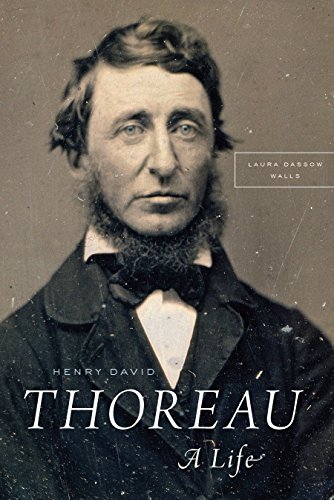
Thoreau: A Life by Laura Dassow Walls

There's not much I can add to the critical acclaim this biography has already received. For pure reading enjoyment, it is one of the best books of its kind. You feel as if you're as close to an understanding of Thoreau as a 200-year gap makes possible. Walls gives us a well-rounded portrait of the man and the writer in all his genius and eccentricities.

Here, you see both the Thoreau who was socially awkward and prickly, who once accidentally set his beloved woods on fire, right beside the warm, energetic Concord citizen who cheerfully led the children out berrying and taught them about nature. If you needed a shed built, a house lot surveyed, a cellar stoned, or a plant identified, Thoreau was always there.

The dreaming Transcendentalist was the same man who figured out a better manufacturing process for the family's pencil business -- who could build his own boat, bed, chair, or house. He grew and entered prize-winning melons at the county fair, made a living as a surveyor, helped runaway slaves to freedom on the Underground Railroad, and stood up for John Brown, even as the fiery abolitionist was being hanged for treason after the raid at Harper's Ferry. But he was still always the dreamer and philosopher -- turning his minute observations of the natural world into ecstatic nature writing, poetry, scientific inquiry, and spiritual epiphany.

One of the most moving things about Thoreau was his continuing struggle to confront and respond to a world that was deeply troubling. His Walden years weren't about becoming a hermit and disengaging -- he was trying to learn how to live a different life, an honest one, that didn't lend support to a culture already turning to overconsumption and indifference to the environment and to a government exterminating Native Americans, making unnecessary wars of conquest, allowing slavery to exist and expand. Walden was a two-year experiment which Walls' book illuminates as only one part of his extraordinary American life.

Walls is often dazzling in her ability to describe the line of Thoreau's thought, as here, when he is contemplating the changing world in the face of industry and commerce.

As the raw wound of the railroad's "deep cut" thaws and flows, he sees in the flowing sands the canvas of creation, revealing the great truth that we live not on the surface of a dead planet but in and through a living earth, like a leaf unfolding.

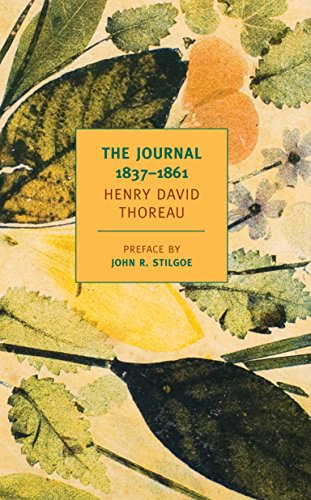
 And after reading 500 pages of Thoreau's biography, you feel as if you're just embarking on a journey -- being led back into his writing, and ready to tackle the most primary source of all -- the Journals that Thoreau kept for almost all of his adult life.


Sunday, July 09, 2017

Henry David Thoreau, July 12,1817


Walden Pond, 2013

Not by design, but reading new biography by Laura Dassow Walls. Thoreau: A Life

Happy 200th Birthday!


Sunday, January 22, 2017

Peacock and Vine: Byatt on William Morris and Mariano Fortuny

Peacock and Vine is a long, thoughtful, and loving essay by A.S. Byatt musing on two famous designers of the late 19th and early 20th centuries. The book itself is a beautiful object, with glossy pages and gorgeous prints and photographs.
Victoria & Albert Museum, "Trellis" wallpaper by William Morris.

Englishman William Morris was the main influence on the Arts and Crafts movement, a return to traditional methods of producing textiles and decorative art. His designs feature intricate patterns of floral and animal prints and other folk motifs, hearkening back to Medieval and Renaissance styles. He was closely associated with the Pre-Raphaelite Brotherhood of artists founded by Dante Gabriel Rossetti. Sometimes the association was a little too close, considering Morris's wife Jane's relationship with Rossetti, who among other things, liked to paint her.

Byatt explains how she came to understand Morris in a kind of counterpoint to the southern aesthetic of the Spaniard Mariano Fortuny, who lived and worked in his 13th-century Venetian palazzo with his wife and artistic partner Henriette Negrin. Fortuny worked as a painter, photographer, etcher, theatrical designer, and couturier. One of his most famous designs is the Delphos dress.

Victoria & Albert Museum, "Delphos" by Fortuny
Fortuny was inspired by the simplicity of ancient Greek designs and the idea to "free" the female form from corsets and layers of undergarments.

Byatt's wonderful novel The Children's Book, focused on a community of artists during the same period (William Morris makes an appearance), and this book is another product of her interest in the question of how great art is made.

Sunday, January 15, 2017

General William Tecumseh Sherman, prose stylist

I spent November and December of last year reading the memoirs of General Sherman, reminding myself that the country had been through some pretty bad times before the election of 2016.

Sherman has a fascinating reputation. If you're from the south, he is a brute, inflicting needless cruelty on a civilian population on his March to the Sea. Otherwise, he is known as a brilliant strategist, a fighter, fiercely loyal, but perhaps a little unhinged. Reading his own words, I was struck by his intelligence and unrelenting belief in the rightness of the Union cause.

Sherman describes his early life in very light strokes. There is not much that is personal, only the highlights. He went to West Point, noting that he was not valued as much of a soldier, but he was a very good student. Unlike Grant, whose standing was at the bottom of his class, Sherman graduated number six in his class and would have been fourth had it not been for numerous demerits received in other areas (apparently tidiness was not among his strengths).

Sherman's early career took him to the Indian wars in Florida and service along the southern coastal forts. He spent the Mexican War in California, then a remote outpost, when San Francisco was a fledgling city. He wrote the report - sent by boat around Cape Horn to Washington - that announced the discovery of gold in 1848. He resigned from the army and went into banking for awhile. Then, he became the superintendent of the Louisiana State Seminary and Military Institute (later to become Louisiana State University), a post he held when the Civil War broke out. One of the things that recurs in his memoirs are the various meetings and correspondence he held during the war with people he formerly knew as friends at West Point and during his years in the south.

Admittedly, I am basing my view of the historical Sherman on what is the one-sided version of events he offers in his own memoirs. Still, I came away with a deep admiration of the man. From the beginning, he was reviled as "insane" when he offered his opinion on the number of troops it would require to hold the central theater of the war in Kentucky and Tennessee. He was basically a nobody - not expected to do well - but ended up, alongside Grant, as the savior of the Union - its most brilliant battlefield general. He was fiery and unforgiving, never shy about letting people have it when they questioned his prosecution of the war or his motives.
You cannot qualify war in harsher terms than I will. War is cruelty, and you cannot refine it; and those who brought war into our country deserve all the curses and maledictions a people can pour out. ... But you cannot have peace and a division of our country.
There is something wonderfully bracing in Sherman's vision of war, even as he acknowledges its inhumanity. To him, war was not grand, glorious, or heroic. It was cruelty and it was destruction, and he never pretended otherwise. You always see him taking the long view and weighing the logic of trying to fight a war of half-measures against an implacable enemy that would take "mercy" as weakness, and waging total war that would be the speediest and surest way to end it, possibly saving countless lives that would be lost in a prolonged struggle. Whatever else one may think of his March to the Sea, the boldness and success with which it was carried out are remarkable. Sherman's genius for the logistics of moving an army across enemy territory for many hundreds of miles with no supply line open behind him is probably unmatched in military history.
I considered this march as a means to an end, and not as an essential act of war. Still, then, as now, the march to the sea was generally regarded as something extraordinary, something anomalous, something out of the usual order of events; whereas, in fact, I simply moved from Atlanta to Savannah, as one step in the direction of Richmond, a movement that had to be met and defeated, or the war was necessarily at an end. 
One thing that is certain, Sherman was a superb writer. His descriptions and his correspondence snap with energy. He imposes order on chaos with words. And sometimes, he is sublime, as in this description of the morning his army departed Atlanta for the long, dangerous trip into the unknown. It approaches poetry.
We stood upon the very ground whereon was fought the bloody battle of July 22d, and could see the copse of wood where McPherson fell. Behind us lay Atlanta, smouldering and in ruins, the black smoke rising high in air, and hanging like a pall over the ruined city. Away off in the distance, on the McDonough road, was the rear of Howard's column, the gun-barrels glistening in the sun, the white-topped wagons stretching away to the south; and right before us the Fourteenth Corps, marching steadily and rapidly, with a cheery look and swinging pace, that made light of the thousand miles that lay between us and Richmond.
...Then we turned our horses heads to the east; Atlanta was soon lost behind the screen of trees, and became a thing of the past. Around it clings many a thought of desperate battle, of hope and fear, that now seem like the memory of a dream; and I have never seen the place since.

Tuesday, October 11, 2016

Escape!

Well, if Americans have anything in common right now, it might be a sudden desire to escape -- the election, the country, the planet. You might pull one of those off, but only temporarily. I spent a wonderful 10 days in London, but of course, books are often the most reliable escape hatch (not to mention, more affordable), always within arm's reach.

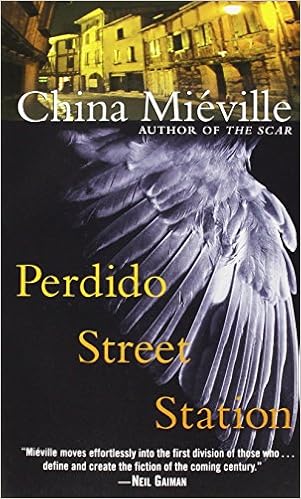
You can't get much further away than falling into one of China Miéville's worlds. The really good writers transcend their genres. Miéville's fantasies are densely detailed and wildly imagined places, fully-realized with their own culture, politics, history, and beings.

In the sprawling city of New Crobuzon humans, humanoids, cactus creatures, flying monsters, demons, dimension-spanning freaky-spider "Weavers," and AI junkyard dogs pursue their individual and intersecting destinies. It is in some ways a very familiar urban landscape, but interspersed with such mind-bendingly alien perspectives and surreal description that you'll be knocked refreshingly off your axis. It combines aspects of steampunk, action-adventure, the occult, horror, picaresque, and tragedy. As with all his novels that I've read, Perdido Street Station is highly-recommended.

Next, I returned to another of my favorite authors, Michael Chabon, and his delightful historical novel, Gentlemen of the Road (or "Jews with swords," as he likes to call it). This swashbuckling adventure is set in the Caucasus mountains in the days when warring khans ruled (around 950 AD). Two unlikely Jewish bandits have partnered up, finding themselves embroiled in a fight to restore a young prince to his rightful throne, which has been usurped by a treacherous villain who wiped out his entire family. It is action-packed and sparkles with Chabon's signature wit and memorable characters.

My all-around literary balm for whatever is ailing me is Shakespeare. I got to see A Comedy of Errors in the place it premiered in 1594 (!) while in London -- the Hall of Gray's Inn. It was farcical and bubbly, given a screwball-comedy vibe by the musically-inclined cast of the Antic Disposition Company. At home, I'll be seeing Macbeth and Titus Andronicus this month, and meanwhile, I just started James Shapiro's The Year of Lear, which is fantastic so far. I'm learning so much about the writing of Lear. Very cool.

I hope you find your own great escapes. Try to get as far away as possible.

Saturday, July 09, 2016

Felix Holt: The Radical

By Mайкл Гиммельфарб (Mike Gimelfarb) (Own work) [Public domain], via Wikimedia Commons
Granted Felix Holt is not considered to be one of George Eliot's best novels. It has an extraordinarily convoluted plot, turning on the most arcane of laws of inheritance and entail on the one hand, some rather startling coincidences on the other hand, and prickly protagonists with whom it is hard to quite fall in love. Still it is the last major novel of Eliot's that I had not read, so I was looking forward to diving in.

Eliot never met a difficult subject that she didn't face head on -- child murder, alcoholism, domestic abuse, the status of Jews in England, suicide, and in this case, political reform and riots. Don't ever think you're "escaping" the modern world by delving into Eliot's Victorian novels.

Felix Holt is set in England after the Reform Bill of 1832 expanded the franchise to more voters. The radical of the title is an idealistic man who believes in workers' rights and education as the path to creating a more equitable society. He eschews anything that smacks of aristocratic or even middle-class pretensions. His refusal to wear the cravat of the "gentleman," even though he is educated and possesses the qualities that could help him rise in station, is a symbol of his dedication to bettering the world, not just leaping at the opportunities that could selfishly propel him to a comfortable life. He meets the beautiful and extremely status-conscious Esther Lyon, the daughter of a dissenting preacher, who desperately wants to escape the barrenness of her provincial life. Their relationship is very much a foreshadowing of Gwendolyn Harleth and Daniel Deronda in Eliot's final novel (Daniel Deronda). Felix's idealism and unselfishness has the uncomfortable effect on Esther of making her aware of her own pettiness and snobbery, chipping away at her supposed superiority.

The plot unwinds in rural England, where politics in the parliamentary election following the Reform Bill take a nasty turn. Electioneering tactics involve inciting a mob mentality to intimidate voters by "buying" their favor with free drinks at the local pub. The candidates are shady or glibly opportunistic -- even the so-called Tory-turned-Radical, Harold Transome, who arrives with his newfound wealth from the east. Remind you of anything?

Here is part of a speech by Felix, who is trying to talk sense to people during the election about all the promises being made:
How can political freedom make us better, any more than  religion we don't believe in, if people laugh and wink when they see men abuse and defile it? And while public opinion is what is is -- while men have no better beliefs abut public duty -- while corruption is not felt to be a damning disgrace -- while men are not ashamed in parliament and out of it to make public questions which concern the welfare of millions, a mere screen for their own petty private ends -- I say, no fresh scheme of voting will much mend out condition. [Felix Holt: The Radical, Chapter XXX]
And this from the same chapter:
But there are two sorts of power. There's a power to do mischief -- to undo what has been done with great expense and labour, to waste and destroy, to be cruel to the weak, to lie and quarrel, and to talk poisonous nonsense....Ignorant power comes in the end to do the same thing as wicked power, it makes misery.

Tuesday, May 31, 2016

Summer Reading Picks - Westerns

 I just  finished my first summer reading, Ivan Doig's memoir, This House of Sky, which was nominated for the National Book Award in 1979. Doig grew up in small-town Montana with his widowed father in the 40s and 50s, bouncing around from ranch to ranch in the areas around White Sulphur Springs and Dupuyer. 


Beautifully written, it vividly describes the lives of hardworking sheepherders, cowboys, and ranchers who battled a hard land, but mostly it chronicles the life of his father and intrepid grandmother, who held together family life after the death of his young mother. Doig gently picks apart the threads of his earliest memories and pieces them together with stories he heard from his family, to recreate a moving portrait of a time and a landscape that he left for a different kind of life.

I've read one other Doig book, The Whistling Season, a novel that evokes some of the same gentle nostalgia as his memoir. I've been thinking of my own fascination with the history of the West and the books that have informed and inspired it. These aren't "genre" Westerns (although I've read some Louis L'amour and Zane Grey along the way). If you're looking for summer reading with a Western flavor, here are some of my favorites in no particular order.


  • Lonesome Dove by Larry McMutry - It actually took me awhile to get to this one, but it seems too obvious to leave off. My husband would say these cowboys talked way too much about their "feelings" (based only on the TV interpretation), but it's a classic for a reason. An epic tale of the west with a cattle drive from Texas to Montana, the tangled lives of cowboys and the women they love, a man in search of his runaway wife, and a prostitute with a heart of gold.
  • The Englishman's Boy and The Last Crossing by Guy Vanderhaeghe - This Canadian writer probably flies way too far under the radar. These stellar novels are part of a loose trilogy set mostly along the Montana and Canadian border. The first one follows a boy's dark adventures among wolf hunters and horse thieves in 1870s Montana, and stretches to 1920s Hollywood where a screenwriter has tracked down the old man to tell his story for a film. The second is a post-Civil War tale of two English brothers who travel to Montana to search for their youngest brother, who has disappeared into the wilderness. They are part of a motley crew traveling on various missions of their own, including a woman who is trying to avenge her sister by tracking down the suspected murderer. Vanderhaeghe died in 2012 but not before finishing the third in this set, A Good Man, which I hope to read soon.
  • Little Big Man by Thomas Berger - This novel was the basis for the Dustin Hoffman movie, but you should read the book. It's as funny a story as can be that begins with a young boy's family being massacred by Indians. Endlessly entertaining, Jack/Little Big Man's adventures among Indians, the U.S. Calvary, gunfighters, and outlaws is irreverent and epic in scope. He claims to be the only white survivor of Little Bighorn.
  • The Son by Philipp Meyer - Another novel that begins with a white boy's family being massacred and himself taken into captivity by the Comanche. It couldn't be more different. Viscerally detailed, it chronicles the history of a Texas family from the 1800s through 2012. I wrote a lengthier review here of this brilliant novel.
  • The Border Trilogy, Blood Meridian by Cormac McCarthy - I wandered into McCarthy when I read the first of the trilogy, All The Pretty Horses. Since then I've read nearly all of McCarthy's work from his early dark and twisty Appalachian novels to his Western masterpieces, including the gorgeous, mythic, and hair-raising Blood Meridian, which I'm contemplating reading again this summer. Because it's awesome.
  • Death Comes for the Archbishop by Willa Cather - Cather is another of those writers I've read extensively. She's masterful in writing about the lives of prairie people, particularly women, but this historical novel is set in the desert southwest, mostly New Mexico. It tells the story of the Catholic priests who started the Spanish missions among the native Americans. It's cast of characters includes Kit Carson and many other rascals and cheats.
  • Fourth of July Creek by Smith Henderson - I loved this novel of 1980s Montana -- a gripping story about a very flawed, but also admirable man, who tries to save people as a social worker, but can't control his own broken personal life, his runaway daughter, or a young kid on the lam with his fugitive father.
  • White Crosses by Larry Watson - Yet another story set in Montana on the border near Alberta. A contemporary tale of scandal in a small town, featuring a mystery, a protagonist with dubious motivations, and a wonderfully complex and textured writing style. 


Tuesday, April 12, 2016

Great Books I Hate: Wuthering Heights

Emily Bronte (Wikimedia Commons)
I was pretty sure I read this novel a long time ago. I even remembered disliking it, which means I must have read it, right? And much like The Great Gatsby (another great book I hate), I thought I should revisit it as a mature adult, and not as a harried college student or doltish middle-schooler. After all, I have a graduate degree in English Lit, a love of 19th century British novels, and Charlotte and Anne Bronte are both among my favorites, so Wuthering Heights would seem to be squarely in my wheelhouse. The first thing that struck me was that I remembered nothing about the narrative structure and the various characters relating the story (dopey Lockwood, annoying Nelly, that sap Isabella). If I never read it, why did I have such a visceral sense of having disliked it? Puzzled, I kept plugging away, and gradually came to believe that I must have blocked it out as one does a childhood trauma. Good lord, I hate this novel.

Emily Bronte was a great poet, a visionary, a square peg in a round hole, no doubt, and for her personally, I have a great deal of admiration. I can only speculate that she died partly from the effort of repressing the consuming rage that would have burned Haworth to the ground, but for her writing Wuthering Heights.

This novel is full of really awful people -- in particular, the romantic duo of Heathcliff and Catherine. Heathcliff makes Lord Byron look like Mr. Rogers. Case in point: Byron loved his dogs so much he wanted to be buried beside his Newfoundland. Heathcliff. Hung. A. Puppy. (Did they leave that part out in the Olivier movie version?) Emily was also a great lover of animals, so I'm guessing she had a point to make about Heathcliff's brutishness. But why are there readers who think he's romantic? (Fellas, if you ever meet a woman who claims to love Heathcliff, run.) He's no Byronic hero. He's not even funny. Actual Byron was a hoot. (“I should, many a good day, have blown my brains out, but for the recollection that it would have given pleasure to my mother-in-law.”) Shakespeare gave his villains all the best lines, but Bronte's Heathcliff  is a cursing crashing boor/bore when he isn't mawkishly blubbering nonsense about Cathy.

There's also nothing sympathetic about Heathcliff. He was lucky enough, as a poor orphan, to be plucked out of the gutter by a generous benefactor. But of course, the other kids were mean to him. If that's the worst thing that happens to a dude in the 1800s, you'll never make it in a Dickens novel. Hell, Emily had it harder than that. (She was a bad-ass. Her sister Charlotte said she once cauterized her own wound from a dog-bite with a hot fire iron.) And his tormented love for Cathy? Oh, boo-hoo. This is what T.S. Eliot would call the absence of an "objective correlative." None of Heathcliff's "sufferings" are enough to account for his overwhelming nastiness. The object of his affection is just as wince-inducing as he is. It's as if Bronte set out to create a Rogue's Gallery of hateful characters.

What was Emily up to here? Sandra Gilbert and Susan Gubar suggest that it is a novel not so much about people as "forces or beings," and that Catherine/Heathcliff are just two halves of one consciousness. Heathcliff is the imaginative "whip" of the powerless female -- a sort of wish fulfillment of the lady who has to sit by the fireside while her other half can go running out on the moors and knock heads together. I imagine a lot of genteel women in the 19th century would have liked to do that, so if you look at Heights not as a novel, but a psychological portrait of frustrated and oppressed womanhood, it at least makes more sense. But it certainly doesn't make it lovable.

Monday, February 22, 2016

Winter Reading: Fervor, fairies, and women who run with wolves

Time flies when you're reading good books, so I really have to schedule some no-fails for the winter. When you're lolling in the sun with a margarita, lesser works will suffice, but cold, dreary days call for something so engaging you forget the ice melt drips crystallizing on the floor and the the itchy layers of swaddling required to ward off icy fingers and toes.

Russian novels always seem like a good fit for the cold season. I read Tolstoy's Hadji Murad, which is about as long as some chapters in War and Peace -- bite-size Tolstoy for those with commitment issues. This slim novel tells the story of a historical Avar guerilla fighter who both fought against and with the Russians in their campaigns to quell the hostile people of the Caucasus in the 19th Century. Tolstoy was inspired by his experience serving in the Russian army at the time. It pits Christian Russia against the Muslim tribes in what is now Dagestan and Chechnya. Tolstoy's admiration for the struggle of Murad as a man of faith (even though not his own) comes through.

Another exploration of faith, Marilynne Robinson's moving and beautiful Lila rounds out her trilogy of novels centered around the quiet, and often troubled lives of two pastors in the small town of Gilead. These are books that take seriously the questions of Christian doctrine, and how it plays out in the lives of two families. They are anything but dry. Robinson's characters contend with faith and doubt, alienation and communion, family ties that bind, but that can't always hold together. Grave, honest, and lovely, Robinson's writing feels like a priestly blessing. She is one of my favorite writers and thinkers. In Gilead, the aging pastor John Ames narrates his life story for the young son that he knows he will not see into adulthood. Lila is the story of his young wife and how their unlikely marriage came to be.

In retrospect, it's as if I read by theme, but it was actually totally random. Sir Walter Scott's Old Mortality is a historical fiction set in the late 1600s in Scotland during the Presbyterian uprising of the conservative Covenanters (some these days might say, right-wing extremists), who fought the Royalists over the right to re-install their particular brand of religion without any interference from the Crown. The hero is Henry Morton, by birth and nurture a more moderate Covenanter, who is torn between his loyalties to his own people and his love for the lady Edith, the daughter of a leading Royalist supporter. It's an adventure novel wrapped up is some very Scottian narrative fustiness, but the accounts of narrow escapes and battles are very good.

Next, I finally got around to Susannah Clarke's Jonathan Strange and Mr. Norrell, already a BBC-produced series, about pre-eminent English magicians working their arts during the Napoleonic wars. An alternate history that brings magic and fairies into the realm of politics and military enterprise, I thought it was great fun. It's quirky in its attention to historical detail while at the same time, completely fantastical, rewriting the battles of the Peninsular Wars and Waterloo by giving Wellington his own magician aide de camp and setting up a showdown between humans, magicians, and fairies in Yorkshire. Sly, funny and smart.

Finally, I actually read a new book -- a novel by Sarah Hall called The Wolf Border, about a biologist whose expertise on wolves attracts the attention of a rich aristocrat in Cumbria. The protagonist, Rachel Caine leaves her work on an Idaho Reservation to head up an eccentric project in her native England. Her skepticism is overcome by a personal crisis that drives her to take on the job of returning wolves to the wild on an English estate. I don't want to reveal too much about the plot, but I loved the setting in the Lake District, the complicated family dynamics, and the conservation aspect of the story. Hall's writing is sharp and engaging. She works the themes of nature and nurture, the instincts of human and animal, the fragile border between wilderness and civilization.

Sunday, November 22, 2015

The Wake by Paul Kingsnorth


Paul Kingsnorth's novel The Wake is a work that takes seriously the importance of presenting a historical fiction in its world as accurately as possible. The opening is 1066, the year that William the Conqueror defeated the English King Harold at Hastings. To reflect the voice of his narrator, Kingsnorth created a "shadow" tongue -- a somewhat modernized version of Old English, using only words of Anglo-Saxon origin throughout. In the quote above, you can see the adherence to original spellings and there is little punctuation. At first glance, it is very foreign, but it takes surprisingly little time to familiarize yourself with the language and to fall into the rhythm of its cadence. If you've ever read Beowulf, it has the lyrical quality of the great epic.

1066 re-enactment by Guardian photojournalist Felix Clay
Aside from the brilliance of its linguistic choices, Kingsnorth creates a memorable character in Buccmaster of Holland (an area of eastern England known for its watery fenns), a man of status and wealth before the cataclysmic Norman invasion. Buccmaster loses everything, his wife, sons, house and land, and is forced to take to the forest as an outlaw. An adherent of the old ways and the gods who reigned before Christianity came to Britain, Buccmaster is determined to drive the French out  and take his revenge by killing every Frenchman he comes across. He becomes a "grene" man, hiding in the shadows of the forest, gathering his men, and stalking the Norman foe. He is led by the elusive and mythical Weland, whose mocking voice comes to him, guiding his actions, sometimes in dreams, sometimes in visions. Buccmaster feels himself "chosen" by the old gods to fight for England. His animosity for priests and the new Christ is almost equal to his hatred of his Norman overlords.
the bastard he cum north from the place where he had cwelled harald cyng and all the way he cum in blud his men they fucced all anglisc wifmen they cum to and cwelled them when done and all hams and tuns they beorned in ingenga fyr. the bastard cum up  to lundun fuccan and cwellan and beornan and the witan it seen what was cuman and it stepped baec and the last of angland that daeg was gan and we had a new cyng who spac not efen our tunge and ate not our foda and cursed us as hunds and curses us still
I don't want to give too much away about the novel or its narrator. It is profoundly disturbing in a way that historical novels often are not. Usually, we feel the comfortable distance between the past and present as something already finished -- antique, quaint, a lost world, decorated in the trappings of legend. And you would think that Kingsnorth's decision to create a foreign-looking language would serve only to heighten the sense that this historical moment is long past relevancy. Instead, it does the opposite. No matter how archaic the language, the circumstances of Buccmaster's dislocation and suffering, the violence described, the culpability of those bought by French gold, the betrayals, shock, and upheaval of Buccmaster's world are immediate and all too recognizable. It reminds me a lot of Cormac McCarthy's Blood Meridian, if that gives you an idea of its effect.

I highly recommend this novel for those who are interested in historical fiction, Anglo-Saxon England, or the unreliable narrator. The pleasure of the language is reason enough to read it, but the story itself is deeply engaging, not to mention, a bit terrifying.


Tuesday, September 22, 2015

Grant's Memoirs

I spent a good part of the summer reading the memoirs of Ulysses S. Grant. He's one of those historical figures who has become almost a caricature -- the hard-drinking, cigar-chomping general who, as the 18th President, led an administration criticized for corruption and bumbling policy.

Grant was rarely out-maneuvered on the battlefield, but he was often nearly undone by gossip and political wrangling, so it's not hard to imagine that his presidency would be undermined by the same kind of elements. But that's just my speculation, so I'm planning to follow up the memoirs with some more objective historical views on his life and presidency.

Grant's intelligence and thoughtfulness define his writing. He was candid, deliberate, fair-minded, and had a knack for incorporating dry humor. My take on him from reading the memoirs is of a thoroughly decent man who held others to his own standards...and was often disappointed. He had no use for pretense, didn't try to duck responsibility or criticism, and didn't waste much time defending himself from the negative press or the petty gossip of his peers. I admired his competence, his doggedness in the face of adversity, and his deep patriotism. There's nothing dry about the writing, even though he gets pretty deep into the weeds of strategy and maneuvers. It seemed to me that he was always weighing the consequences of failure in the face of the overwhelming brutality of the war, and that's how he was able to continue to absorb its blows.

Later in the war, when the battlefield losses in the Wilderness campaign were staggering, beyond even what had come before, Grant was criticized for being no better than a butcher. But in his view, enduring the monumental loss of life was the only way to end the war. Prolonging it without completely crushing the south was not an option -- there could be no negotiated peace, and there could be no compromise on the issue of slavery. At the beginning of Volume 2, after Vicksburg had fallen to Union forces and Gettysburg had been decided in the North, Grant interrupted his narrative on the military progress of the war to give his opinion on why the South must be defeated -- for its own good.
There was no time during the rebellion when I did not think, and often say, that the South was more to be benefited by its defeat than the North. The latter had the people, the institutions, and the territory to make a great and prosperous nation. The former was burdened with an institution abhorrent to all civilized people not brought up under it, and one which degraded labor, kept it in ignorance, and enervated the governing class. 
He goes on to describe the bleak and ruinous future that he believed awaited the South if it had succeeded in making itself a nation, separate from the Union, and concluded, "The war was expensive to the South as well as to the North, both in blood and treasure, but it was worth all it cost."

Of course, I was reading Grant just as the Confederate flag controversy was rearing its ugly head again in the news, which made me realize how much the Civil War still haunts us, how it is not so far removed in time, and how little some people have heeded its lessons.


Monday, May 25, 2015

The Art of Recommending Books


One of my favorite things about working in bookstores was being able to recommend books to people who didn't quite know what they were looking for. They had an idea of a book, they knew what they had liked, but they didn't have anything particular in mind. It was an opportunity to hand-sell books that I loved -- under the radar, backlist, or a forgotten classic -- in any case, a departure off the NYT Bestseller list for those who didn't want the same trendy book that everyone else was reading.

Of course, you have to be careful. Not everyone is going to appreciate the necrophiliac protagonist of an early Cormac McCarthy novel. If you were to even start telling someone about the plot of Child of God, they might start edging away down the self-help aisle and wondering if they should alert the authorities. I've had someone tell me that they tried to read Hilary Mantel's Wolf Hall and wanted to throw it across the room, which makes me wish I had a copy to hurl back at their head, but... then I have to admit that it's really NOT for everyone's taste and it doesn't make them a bad person (necessarily).

So I try to think of things that readers would like based on what snippets of interest they've told me about, when and where they're planning to read it, and my gauge of their attention span. I know from my own idiosyncratic moods that some books have to wait for the right moment. I read Moby Dick the first time one summer while in grad school out of some kind of self-imposed, English major compulsion, liking some parts and finding much of it completely tiresome. The second time around, when I had a little more context and read it because I was interested in Melville and that whole era of writers, I LOVED it. I'm enamored with it. I'd happily read it a third time, and all the difference is when I was finally ready for it.

And some things are never going to click. One of the first serious recommendations I ever received from an adult who saw me as a budding writer was The Great Gatsby, which is totally understandable. It is a virtually undisputed American classic. You want to get some starry-eyed kid off on the right track in American literature, you go for Gatsby. So I dutifully read it as an eighth-grader, and of course, I didn't like it. What could a little Appalachian bumpkin possibly understand about all these whiny, affected rich people, drinking gin and dressing up in tuxedos for no apparent reason? Which is why I re-read it not too long ago -- because for crying out loud, it's F. Scott Fitzgerald. Yeah, I still hate it. I hate all those characters, especially the narrator, and even if you put Leo DiCaprio in the movie version, I still hate it. Is hate too strong a word? It's not to my taste.

And so fellow-readers, with that in mind, here are some entirely random recommendations for your summer reading. You might like them. You might want to employ them as a projectile. Who knows?

The Goldfinch by Donna Tartt. My favorite of her three novels so far (and I've liked them all), it is an epic, touching, adventurous, heartbreaking, thoroughly engrossing novel about love, friendship, and art. Tartt is intellectually imposing while still being approachable and funny. If you want to throw this book, there's no hope for you, despite everything I just said.

The Forest Unseen: A Year's Watch in Nature by David George Haskell. For those of a naturalist's bent, a gorgeous book about plants and critters the author observes over a year in a wooded spot about the size of a mandala.  Also Scott Weidensaul's Mountains of the Heart: A Natural History of the Appalachians. I love his writing and, growing up in these mountains myself, I learned a lot about the special geography of the place.

The Girl on the Train by Paula Hawkins. Here's something that almost never happens -- I'm recommending a novel that absolutely everyone else seems to be reading -- a bestseller, a mystery, someone probably already has the movie rights. Clever and well-written page-turner, this is Ur-summer reading material. I read it because my mother made me read it, and I ALWAYS listen to her. Yes.

Lincoln at Gettysburg: The Words that Remade America by Garry Wills. A really smart, engaging, concise, power-house of a book that elucidates what makes this short speech so revolutionary in American history. My husband made me read it, and I ALWAYS listen to him, too.

Incarnadine: Poems by Mary Szybist. I don't read nearly enough poetry these days, but this is one contemporary collection I did catch. Beautiful and mysterious encounters between the everyday and the otherworldly -- reimaginings and recastings of the Annunciation. Also Elizabeth Bishop, The Complete Poems, 1927-1979. She's one of my favorite poets, and there's a new book by Colm Toibin on Elizabeth Bishop that I have on my own list.

A few others that I've written about in more detail already: Smith Henderson's Fourth of July Creek; A.S. Byatt, The Children's Book; Hild by Nicola Griffith, anything by Michael Chabon.


Monday, April 06, 2015

Spring reading

I finished up my project to read all of Shakespeare by his birthday this month. I ended with Pericles, even though I realized right after I started it that I had read it in graduate school. Obviously, I didn't remember it very well. It's one of the "disputed" authorship plays -- probably taken over by Shakespeare at some point (it was not included in the First Folio). I think we read it in school primarily to illustrate the difference between the rather mediocre writer of the first part and the more assured second half, presumably when Will took over. There are clear echoes of The Tempest, and of Winter's Tale for the sheer implausibility of the plot. Another of the last ones on my list was The Merry Wives of Windsor, featuring the reappearance of the ever-popular Falstaff from the Henry IV plays. As a main character and butt of all the jokes, Falstaff is just kind of sad and pathetic, and none of the other characters really stand out in this farce. But there you go, they can't all be gems. Sometimes, a hard-working showbiz guy just has to churn out Fast and Furious XXIV.

What I learned from reading through Shakespeare was how entertaining the history plays are. I had never read King John, Henry VIII, or any of the Henry VI trilogy. The history plays feature great characters, beautiful speeches, and ruthless action. They are fascinating for their spin on history, particularly how H6 portrays the Wars of the Roses. It inspired me to read an excellent history of the time period by Dan Jones. The tangled politics, betrayals, and side-switching still make your head spin, but it will shed a little light on this brutal slice of England's history. It was also timely, as they just reburied Richard III after recently digging up his bones in a church parking lot. 

"Illiers-Combray" by Oxxo - Own work.
Licensed under CC BY-SA 3.0 via Wikimedia Commons
While I was feeling all sassy from that literary milestone, I went ahead and jumped into another one, finally tackling the first leg of Marcel Proust's multi-volume À la recherche du temps perdu. Volume 1 includes the parts, Combray and Swann in Love.  (I read the updated translation of C.K. Scott Moncrieff and Terence Kilmartin by D. J. Enright.)

Combray is Proust's fictionalized memoir of his childhood, and if you've ever spent any time thinking about your own fragmented memories, particularly wondering why some small incidents or details stand out over all the rest, you'll be interested to see how Proust explores this phenomenon.

I've often puzzled over the weird little moments that have imprinted themselves on my mind -- and how the vast majority of moments over all those years have just disappeared into the fog of memory. Smells, tastes, feelings, visual impressions scatter like the downy seed of a dandelion head. Proust re-creates a world, literally in search of a lost time, built on nuances, putting into words things that we don't usually even try to capture because they are so elusive or so befuddling. For him, they include the delicate taste of madeleines dipped in tea, flowering hawthorns in spring, his mother's goodnight kiss, the limbo-land between sleeping and waking when you don't remember where you are or even who you are. Sentences unwind across pages and don't so much describe, as paint an impressionistic landscape of accruing details. If I were to try to do the same thing, I would be reconstructing a life from the smell of the riverbank, climbing a fence in my nightgown on a moonlit summer night, my grandpa's old black rotary phone, the terrible excitement of being small in a ferocious wind that felt like it could pick me up and carry me over the fields. These are the strange things that Proust will lay before you, whether or not your life resembles that of a turn-of-the-century Frenchman.

But for me it was enough if, in my own bed, my sleep was so heavy as completely to relax my consciousness; for then I lost all sense of the place in which I had gone to sleep, and when I awoke at midnight, not knowing where I was, I could not be sure at first who I was; I had only the most rudimentary sense of existence, such as may lurk and flicker in the depths of an animal's consciousness; I was more destitute of human qualities than the cave-dweller; but then the memory, not yet of the place in which I was, but of various other places where I had lived, and might now very possibly be, would come like a rope let down from heaven to draw me up out of the abyss of not-being, from which I could never have escaped by myself: in a flash I would traverse and surmount centuries of civilisation, and out of a half-visualised succession of oil-lamps, followed by shirts with turned-down collars, would put together by degrees the component parts of my ego. [Combray, Project Gutenberg] 


Sunday, February 08, 2015

CSI: Shakespeare

I've been embarked on a reading project of Shakespeare since about September, when I decided to read back through all the plays, and catch what I had never read. The history plays have been fascinating. Right now, I'm through Part 1 and still reading Part 2 of  King Henry VI. In Part 1, Joan of Arc gets totally trashed. In Part 2, all the gears are in motion for the War of the Roses.

Henry VI's uncle, the Duke of Gloucester has just been dispatched by the Duke of Suffolk. Rumors are he has been murdered in his bed, but squeamish Henry can't bear to view the body of his uncle and Protector, who has been accused of treason by his enemies. So Henry asks the Earl of Warwick to have a look and report back. Oh, how I wish it was this awesome on CSI:
Warwick:
See how the blood is settled in his face.
Oft have I seen a timely-parted ghost,
Of ashy semblance, meagre, pale and bloodless,
Being all descended to the labouring heart;
Who, in the conflict that it holds with death,
Attracts the same for aidance 'gainst the enemy;
Which with the heart there cools and ne'er returneth
To blush and beautify the cheek again.
But see, his face is black and full of blood,
His eye-balls further out than when he lived,
Staring full ghastly like a strangled man;
His hair uprear'd, his nostrils stretched with struggling;
His hands abroad display'd, as one that grasp'd
And tugg'd for life and was by strength subdued:
Look, on the sheets his hair you see, is sticking;
His well-proportion'd beard made rough and rugged,
Like to the summer's corn by tempest lodged.
It cannot be but he was murder'd here;
The least of all these signs were probable.
Warwick don't need no stinking coroners! It's a slam-dunk:
Who finds the heifer dead and bleeding fresh
And sees fast by a butcher with an axe,
But will suspect 'twas he that made the slaughter?
When Suffolk dares refute this evidence, Warwick shoots back with the timeless "yo mama" insult:
But that the guilt of murder bucklers thee
And I should rob the deathsman of his fee,
Quitting thee thereby of ten thousand shames,
And that my sovereign's presence makes me mild,
I would, false murderous coward, on thy knee
Make thee beg pardon for thy passed speech,
And say it was thy mother that thou meant'st
That thou thyself was born in bastardy;
And after all this fearful homage done,
Give thee thy hire and send thy soul to hell,
Pernicious blood-sucker of sleeping men!
- King Henry VI, Part Two, Act 3, Scene 2 
It really is rather delicious.

Sunday, February 01, 2015

Fourth of July Creek

I started off the new year right with my first book pick. I had read some pretty glowing reviews of Smith Henderson's debut novel, Fourth of July Creek, when it came out, but had kind of forgotten about it until it finally became available as an eBook from my library. It may be a first novel, but it reads like an instant classic -- a gripping story, great characters, and beautifully descriptive language that is lyrical and immediate.
Medallions from the quaking aspen lay about in a golden hoard, blowing up in parade confetti as he drove through them. A few Indian paintbrushes still glowed red like small tissue-paper fires at a grade-school play. Pete felt a homesick sorrow at the little differences, at time itself....The place looked shorn, fussed over like a toy dog.
The protagonist is Pete Snow, a social worker in northwest Montana, whose family life is almost as screwed up as any of the people he serves. The year is 1980 and the Reagan era is dawning. Pete becomes involved with an anti-government fugitive whose young son he is trying to help while also searching for his own runaway teenage daughter. He is an alcoholic and pretty terrible at dealing with his personal relationships, but at bottom, he is a good guy. Henderson brings Pete to life in all his failures, his noble attempts, his personal disasters, and his doggedness in pursuing a job that is mostly grim and thankless.

Henderson has an uncanny knack for capturing a character's inner voice, both adults and children, and his dialogue rips right along, natural and succinct. There are moments of humor and quiet beauty among the many dark corners of this novel as it subtly reveals a great truth -- even the most broken people can sometimes do good.

Finely observed and anchored in a very particular time and place, the novel also has some lovely descriptions of the rugged landscape near the Flathead River and Kalispell. I would place Henderson in the same literary space as Larry Brown and Philip Meyer. It is definitely one of the best first novels I've ever read.

Wednesday, December 31, 2014

The year of the book backlog

I realized as I looked back over this year's reading that I hadn't read a single book that actually came out in 2014. I'm so far behind that I haven't yet got to Donna Tartt's The Goldfinch, which I had intended to read as soon as it came out. Ditto for the incomparable Marilynne Robinson's Lila.

Here is just how dawdling I am: I finally read A.S. Byatt's The Children's Book, which I've had on my shelf since it was published in 2009. What a beautiful, haunting story it was, set during the gloaming of Victorian England through the end of WWI. Epic in scope, it traces a history of the arts in those years -- painters and potters, writers and dramatists -- through a sprawling Bohemian family and their circle of friends. Some of the characters reminded me of the poets Siegfried Sassoon and Robert Graves, which brought another long-neglected book out of the dust -- Jean Moorcroft Wilson's momentous biography of Sassoon: The Making of a War Poet (volume one is a hefty 600+ pages). I believe Wilson could tell you what Sassoon had for lunch on any given day -- it's that thorough. I bought it hot off the press in ...1999! Ye Gods, I actually gave Wilson enough time to complete and publish the second volume, which came out last May. I hope it won't take me another decade and a half to get to it.

In retrospect, I pretty much disappeared down the rabbit hole of the WWI era this year. I returned to Graves' stunning The Great War and Modern Memory, which is the book that inspired my master's thesis and introduced me to Sassoon, Graves, and Wilfrid Owen in the first place. I began the year with Somerset Maugham's The Razor's Edge, and finally read Hemingway's The Sun Also Rises, Evelyn Waugh's Decline and Fall, and Lawrence's Lady Chatterly's Lover -- a much better book than I was expecting it to be. I think it's reputation has been distorted by all the sensation it stirred up with it's frank sexuality, but there's so much more to it. The Great War looms large, of course -- with its shattered men, the fractured relationships between the sexes, and the increasing assault on nature of a rampant mechanization and industrialization that was ushered in by the cataclysm on the Western Front.

 In no particular order, here are some of the other books I read this year and enjoyed:

Lewis Lockwood's life of Beethoven, which taught me a thing or two amongst all the stuff about his music that went right over my head...

Willa Cather's The Song of the Lark, a lovely novel which chronicles the growth of an artist through the life of its heroine, Thea Kronborg.

Indiana by George Sand -- someone I'd like to read more from... (recommendations?)

Incarnadine, beautiful poems by Mary Szybist.

My Own Country by Abraham Verghese about treating AIDS patients in the 80s in the small cities and towns of Appalachia.


Sunday, December 28, 2014

What makes a classical music fan?

Austin's Mother Falcon at Zanzabar
Now that I'm writing about music on a fairly regular basis as a freelancer, I spend a lot of time thinking about music. One question I've been noodling is what makes me a fan of the opera and orchestra at a time when dwindling audiences and revenues for both seem to be the norm in many places?

One reason this question has bubbled to the surface for me is the recent arrival of our new music director for the Louisville Orchestra, Teddy Abrams. He's obviously on a mission  to revitalize the orchestra - putting the musicians out into the community, trying to win new fans, and coming up with creative programs that will draw a more diverse audience. Kentucky Opera, under the direction of David Roth is also experimenting with programs that feature new works and more rarely performed operas. Will it work? How do people become classical music fans? Why am I one?

I'm not exactly the poster child for classical music fandom. First of all, unlike my husband, who was in band and his college orchestra, I totally lack any hands-on musical education. I regret now that I never tried to make music myself. I formed my passion for reading and writing so early that it pushed other pursuits to the margins. When you've already decided by age 8 or 9 what you want to be when you grow up, you tend to be laser-focused on that one thing. I never thought about being in the band or taking up an instrument, even though I had close friends and family who did. I'm sure I was so much in my own little world of books and scribbling that it didn't occur to anyone to distract me from it with encouraging words about music lessons. Well, at least I had a thing!

Part of Mom's collection
 Second, I grew up in a tiny town in Southwest Virginia in the very heart of country and bluegrass music where the nearest orchestra halls are hundreds of miles away. Family get-togethers often included (and still do) some kind of "picking." I love that kind of music, but I also learned to love a lot of other styles, and when I started to think about it, I realized that I had been listening to classical music since I was a child.

I played the vinyl we had at home from the time I could operate the turntable, so I credit my mother's record collection for my complete disregard of genre.  It was everything from Jerry Lee Lewis and Elvis to Sarah Vaughn and the Four Seasons. Chubby Checker and Connie Francis were early favorites, along with classical music compilations and Herb Alpert. My ten-year-old self was just as likely to be listening to "Twist" as Bizet's "Habanera." Willie and Waylon lay cheek by jowl with Pavarotti and the "Evita" soundtrack I had checked out from the local library.

The other big influence on my musical tastes was Great Performances. We usually could tune in about two-and-a-half TV stations where I grew up and one of those was PBS, thank God. I watched ballet, orchestra, and Met operas. I vividly remember "Rigoletto" with Pavarotti playing the Duke. I don't know why it made such an impression on me except it was very dark, and I was a little girl with a decided affinity for the macabre. There was also a production of "Lucia di Lammermoor" that I loved. Who can resist a madwoman in a bloody, white gown screeching down the staircase after dispatching her husband with a dagger on her wedding night? Now that's entertainment! At least to those of us raised on Appalachian murder ballads. (Belated kudos to Marilyn Mims who played Lucia when I finally saw it live at Kentucky Opera in the 90s.)

In college, I was very involved in drama, and of course, there was a lot of cross-over between the fine arts departments. I went to all my friends' concerts and recitals, so I never really lost interest in classical music, particularly opera, which combined music with theater. In graduate school, working two or three jobs and going to class, I was all about the free music opportunities. One of  the more memorable was Sam Ramey performing a solo show one night on campus. Whoa! Mephistopheles ... totally dreamy. You can keep your Barihunks.

One thing I'll extrapolate from all of this, is that it's important to capture the imagination of kids if you want to grow the next generation of classical music fans. You don't have to explain the plot of an opera to them, and for God's sake, don't imply that classical music is good for them. Is anything more deadly than an adult telling a child what they should like? No one ever did that to me. Just let 'er rip and see what they latch on to. It doesn't have to make any sense. Arts programs in schools have fallen on hard times, but all it takes is that one magical musical experience for a child to be hooked. I don't think anything is more important than having the orchestra, ballet, opera, etc., get into schools and libraries as often as possible with their outreach programs.  Clearly, this is a long-range plan.

And is it possible to turn the 20- and 30-somethings into classical music fans if they've never been exposed before? Well, it's at least as possible as convincing them that a handlebar mustache is a good look or that Pappy Van Winkle should be served as a jello shot. Social media is the key. If you can project yourself positively into the craft beer and cronut crowd, then you might lure them to a concert. If you make it cool, they will come.

Open it up, invite more people, make new friends. I think all these things help shake off the stuffiness that still clings to orchestras and opera companies. I know that I've heard more people talking about the orchestra in the last year than I ever have before. And as someone totally invested in having a healthy arts community in my city for years to come (because it's all about me!), I'm for anything that puts butts in the seats.


Sunday, November 02, 2014

The Shakespeare Project

Shakespeare's bust in the ceiling
 of the Louisville Palace Theater.
One of the shows I attended this fall was a very inventive production of Love's Labor's Lost at Actor's Theatre in Louisville. Many years ago, this was the first Shakespeare play I ever saw performed at the Barter Theater in Abingdon, VA, near my hometown. Full of nostalgia, I reacquainted myself with it before going to Actor's, which reminded me why this new version chose to jettison entire scenes, conflate characters, and insert a mashup of famous Shakespeare lines from other plays. Much of the original is completely impenetrable to a modern audience! There are whole scenes of wordplay and jokes based on what was probably very topical at the time, but the references are so obscure now that the scholars can only guess at what precipitated the jokes in the first place.

The experience got me to thinking about plays I wanted to read again, and the handful of plays that I've still never read. So, I thought, why not work my way through all the plays, reading one a week from now through next spring? I might even finish by Shakespeare's birthday!

Branagh as Macbeth 
I actually started in September with LLL. Macbeth was next because I've been mourning the fact that I didn't see Kenneth Branagh's production at the Armory this summer. Then, Richard III, who has been on my mind, since his poor bones are still being jostled about and fought over by Leicester (where they were dug up) and York (where many think he should be buried). There has been an ongoing effort to revive his reputation, but Shakespeare is a pretty formidable spin doctor.

R3 is a treasure trove of over-the top insults, most of them flung about by the female characters in the play. "Never hung poison on a fouler toad. Out of my sight! thou dost infect my eyes." So says Lady Anne on being wooed by toady Richard who has just killed her husband. "He that bereft thee, lady, of thy husband, Did it to help thee to a better husband." He's so wicked and witty. I love this scene, and I can't wait to see Benedict Cumberbatch's take on it in the excellent Hollow Crown series.

I finished up September with one I had never read, The Two Noble Kinsmen. It's actually co-written by Shakespeare and his contemporary John Fletcher. It's a weird little play, adapted from Chaucer's "The Knight's Tale" in the Canterbury Tales. It's weird mainly because the action seems so improbable and then most of the really interesting stuff happens off-stage. The two kinsmen are friends and cousins, Arcite and Palamon, captured prisoners from Thebes being held in the court of Theseus, Duke of Athens. Though one is banished and one manages to escape, they are both in love with the Athenian Princess Emilia, which sets them at odds. There is no actual interplay between Emilia and either of her lovers, and then the contest that decides the winner is not dramatized. There aren't any particularly beautiful quotable quotes, which makes this play rather dull.

In October I read, King Lear, Troilus and Cressida, and King John (I'm running behind -- I should already have read The Comedy of Errors, which is next on my list). Maybe the most surprising of the three was the one with which I'm most familiar. I've read it, wrote about it, and seen it performed a couple of times. Reading Lear again, I found it more moving than ever. I think there are aspects of this play that you only appreciate as you get older -- when the potential reality of helplessness, dependency, and weakness is enough to scare the bejesus out of you. It's a play that is truly timeless in the way it depicts the humiliations of old age, the revelation of family loyalties, and the wolfishness of those eager to fill the gaps left by the superannuated.

I encountered Troilus and Cressida in graduate school, but it hadn't really stuck with me. It is most interesting for it's absolute bleakness and it's lack of any hero. It is set during the Trojan War, and provides a scathing perspective on wars based on empty and pointless causes. Hector is the most level-headed and he is often the most blunt  in his criticism of the stupidity of the war, but even he is blinded by the idea of "glory and honor" won in battle. His brutal end is one of the most searing commentaries on those twin ideals in literature -- at least until the Great War poets, Sassoon and Owen come along. I would like to see a production of this one day. It is considered to be distinctly modern in the way that it deconstructs any kind of sentimental or romantic ideas about war, love, attachment, or heroism. It was written around the same time as Hamlet (1602). Shakespeare must have been in a pretty grim frame of mind for awhile.

The last that I've finished is King John, which I'd never read and had no familiarity with even the basic plot. I was kind of expecting it to be a dud (as Shakespeare goes). Oh, but no! I loved it. It has some of the most entertaining dialogue in Shakespeare, and a great character in Falconbridge (aka Philip the Bastard, aka Richard Plantagenet), the illegitimate son of Richard Coeur de Lion. In Shakespeare's world, bastard sons aren't usually the good guys (i.e., the horrible Edmund of Lear), but in King John, he's one of the few truly noble characters in his actions, an irreverent silver-tongued devil in his speech. When his brother has him declared illegitimate and leaves him without land or fortune, Falconbridge declares his loyalty to King John (also his uncle). He gracefully excuses his mother's faithlessness, thus:
Some sins do bear their privilege on earth,
And so doth yours; your fault was not your folly:
Needs must you lay your heart at his dispose,
Subjected tribute to commanding love,
Against whose fury and unmatched force
The aweless lion could not wage the fight,
Nor keep his princely heart from Richard's hand.
He that perforce robs lions of their hearts
May easily win a woman's.
Another thing I like about King John are the female characters. There is the intimidating Queen Elinor, John's mother, and the rather crazy Constance, mother of Arthur, a claimant to John's throne. Here is her speech, when she finds out Arthur is dead:
No, I defy all counsel, all redress,
But that which ends all counsel, true redress,
Death, death; O amiable lovely death!
Thou odouriferous stench! sound rottenness!
Arise forth from the couch of lasting night,
Thou hate and terror to prosperity,
And I will kiss thy detestable bones
And put my eyeballs in thy vaulty brows
And ring these fingers with thy household worms
And stop this gap of breath with fulsome dust
And be a carrion monster like thyself:
Come, grin on me, and I will think thou smilest
And buss thee as thy wife. Misery's love,
O, come to me!
I would thank that any actress would relish the chance to speak these wildly over-the-top speeches!

I'll try to catch up in November, but the fall arts season has been a busy one. Now that the time has changed and I'm facing what I expect to be a long and dreary winter, I expect I'll have more time to cuddle up next to Will. Here's hoping he makes the journey to springtime a little more bearable.
Tuesday, July 15, 2014

Summer reading: Road trips and Americana

It's hard to believe that we are this deep into summer already. The kiddos will be back to school next month, football season will start, and this vague thing we call "summer reading" will be over. I'm not sure that I've found my quintessential book of the season. I read Jack Kerouac's On the Road right before my own road trip, and I enjoyed it much more than I expected. Toward the end, I found it a bit tiresome. It began to seem repetitive and aimless. I've never really identified with the Beat generation that much and I don't find Kerouac's style of writing to be that engaging over a long haul. I am, however, interested in the Beats as a response to World War II, and I think I might enjoy reading something that gives a little more context to the movement.

Much more to my taste was Rebecca Mead's My Life in Middlemarch, in which Mead explores her relationship to George Eliot's novel over the years since she first read it. Eliot is my favorite author, and I understand how a book can seem to speak to you on a level that feels very personal and direct. I had a similar feeling about Daniel Deronda when I read it. There were things going on in my life that mirrored the struggles of some of the characters in the book, and Eliot's wise and sympathetic voice was comforting. She penetrated the complicated psychology of  people who are searching for identity and meaning and offered a large-hearted understanding of the misguided things we do in the attempt. Mead's book made me want to re-visit all of Eliot. I have saved Felix Holt as the only one of her works I haven't yet read. With what nerdly relish I contemplate reading an Eliot novel for the first time!

I read Karen Russell's Swamplandia! next. It received swooning reviews and was on everyone's "best" lists. About an alligator-wrestling family in the Ten Thousand Islands off Florida's Gulf Coast, it has an engaging young heroine, 13-year-old Ava Bigtree, and quirks aplenty. It's one of those books that in the end seemed less than the sum of its parts. The writing was great, the characters were likable, the setting was exotic, and yet I didn't love it. The tone of the ending didn't seem to match up with the rest of it somehow. It was actually pretty depressing. I do enjoy Russell's gift for dialogue. The sections about the oldest brother of the Bigtree clan and his struggle to fit in (or just survive) on the mainland were very funny to me.

I just finished Ian Frazier's Great Plains, which was published in 1994. Rambling around the Plains states, Frazier describes the landscape and the people he encountered while visiting historic sites, museums, ghost towns, and abandoned dwellings, offering a thoughtful exploration about what the Plains mean to the story of America. Along with more familiar episodes and characters like Crazy Horse, Bonnie and Clyde, the Clutter murders, and the Dust Bowl, Frazier tells some of the lesser known stories: about the last man lynched in Kansas, the African-American settlement of Nicodemus, and finding Sitting Bull's cabin. He is funny, conversational, and passionate.

I'm not sure what's next. I have a house full of books and library ebooks that are just a click away. What are you reading?

Friday, June 13, 2014

Montana and Yellowstone (A tour of the West)

Montana


My father first hitchhiked out to Big Timber from Virginia when he was 16-years old to work on a ranch owned by extended family, but eventually he wound up in Jordan, Montana on his later trips for hunting. He would stay a month at a time, so I was never able to go. I enjoyed the stories of the people he met -- the ranchers and assorted small-town colorful characters, as well as descriptions of the landscape itself. I've lived with these stories a good long time, and I suppose as one gets older and you start to think of your parents as actual people, you get to wondering what it is that makes them tick. So I wanted to see my father's Montana, and this is where we depart from any travel route you're likely to take.

Jordan is the seat of Garfield County, described as the most remote county seat in the lower 48 states. It will probably not be on your Western itinerary. Just north is the Fort Peck Reservoir, so if you're a fisherman or a hunter, then you might find yourself in the neighborhood. Otherwise, it's only renown is for the Freemen uprising in 1996 and for its rich dinosaur fossil fields in the Hell Creek Formation nearby. From Miles City, you drive northwest about 84 miles through undulating low hills and pasture land, dotted by sagebrush, dressed momentarily in spring green for us. To my father, it was always brown and sere in September, empty and practically treeless, a straight road to a place only a few can love. I thought it was peaceful and beautiful in its spareness. Farms and a couple of tiny crossroad communities lie in between. I might have seen my first antelope along this road, just one or two wanderers, picking through the sage. They are very graceful, gentle looking creatures, golden brown with big patches of white on their rumps and stubby little tails. They would not look out of place on an African savanna.

Pulling into town, it looks dusty and quiet. At the crossroads is the Garfield Motel where we stayed. The desk is empty, but if you pick up the phone, someone will answer and scoot on over to check you in. I'm not sure if anyone else was staying there. The good news is, you can walk to just about anywhere you want to go in Jordan, as all the businesses are clustered around very handily. There's a museum where you can view area fossil finds (closed by the time we arrived), pharmacy, coffee shop, grocery, garage -- all your basics. Of the several bars, we went to Hell Creek Bar, where my father would stop in on his trips. This was Memorial Day, so probably not the most hopping time to be in town. There were only a few patrons and one long table that looked like a family having dinner. I ordered Wild Turkey (unusual for me, but good) and we had bar food for dinner. Don't come to Jordan for the cuisine. 

But the point is, I was finally there, perhaps sitting on the same bar stool where my father sat, and I would have called him had I had any cell service. We asked after a friend of my father's who owns a ranch nearby, but he wasn't in that night and we didn't know how to get in touch with him. So there we were in Jordan, Montana for no earthly reason other than it's the place my father liked to go. I wonder what the locals thought of us greenhorns showing up for an overnight stay and then disappearing without a trace. No one asked us any questions, but they were perfectly friendly. I expect that they do not tend to pry. I even wandered around the streets as dusk came down, swung on the swing set at the elementary school, smelled the fragrant shrubs blooming (lilacs?) here and there, snapped a picture of their war memorial where I expect they had some sort of remembrance earlier in the day. A good number of WWI names as well as WWII and other conflicts. I'm sure a few people saw us meandering. I hope they made up some good stories about us.

Little Big Horn

Little Bighorn Battlefield looking uphill where Custer made his last stand.
Not wanting to retrace the same ground on our circuitous southern path to the Little Bighorn Battlefield, we headed due west out of Jordan along Route 200, and traveled about 100 miles through sagey grassland, buttes, and coulees populated by mostly cows and browsing antelope. Cross the Musselshell River and eventually in the distance are the Judith Mountains to the north and the Snowy Mountains to the south. You hang a left at Grass Range and go another 90-odd miles on 87 to Billings. By this time, we are listening to Francis Parkman's decidedly dated but still engaging memoir, The Oregon Trail, a misnomer, as he didn't actually go all the way to Oregon, but went part ways, following his own interests (among them was living for awhile with a Sioux tribe, who apparently found him interesting or amusing enough to keep around).

All the Indians this Bostonian meets in 1846 are "savages" and the immigrants, trappers, hunters, Mormons and soldiers rarely fare much better in his opinion, but it is an interesting window on the prevailing attitudes of the time. His descriptions of life on the trail are meticulously detailed, full of adventure, and appropriately florid. Herman Melville reviewed it and liked it well enough but thought Parkman was too contemptuous of the Indians. "When we affect to contemn savages, we should remember that by so doing we asperse our own progenitors; for they were savages also." Melville needn't have gone so far back to find savages among the whites, but at least he's on the right track.

Well, now we're back on what might be any normal person's itinerary of the West. Traveling partly along I-90 southeast another 60 miles, we came to Little Bighorn in the Crow Agency. History buffs, we couldn't pass up a chance to view the storied battlefield. We didn't take any of the guided tours, but they do offer them and at least one is led by Crow Indians for the Native American perspective. There is also a  memorial dedicated in 2003 to the Native American tribes who took part in the battle -- Cheyenne, Lakota, and Arapahoe -- just down the hill from the monument to the fallen 7th Cavalry.
It's a lovely wheel-like monument with openings meant to represent gates to the spirit world where both soldiers and Indians meet again in the infinite. A bronze silhouette of Indians on horseback is traced against the sky and prairie.

We walked along the trail that ran down the hill where Custer made his stand to the deep ravine where many of his men were trapped and cut down easily by the Indians, who had the high ground on the edges of the coulee. It presents a stark realization of just how desperate the fighting must have been, and how completely wrongheaded it was to pitch a battle that set about 260 U.S. troops against the thousands encamped around the Little Bighorn in the valley.

White marble markers of the dead are erected where soldiers fell (marked by the Army when the bulk of it arrived a few days later). Newer markers of red granite have joined them as Native American historians have documented their own dead from the scarce records. Driving the length of the battlefield, the scattered remnants are lit by the sun in the waving grass. It's sad and eerie and oddly jarring as all preserved battlefields are -- all that terror and violence distilled down into a tranquil landscape that looks as peaceful as a dream, as if we were trying to blot out the pain of what once happened there.

Our third and final book for the journey was Larry McMurtry's short life of Custer. McMurtry is very good at fleshing out Custer and his wife and the rather long list of people who despised him. Custer was pretty easy to dislike, if for no other reason than his total disregard for getting his own men killed. I think he was a sociopath. One might argue that he put his own life in danger as well... except when he didn't. He was court-martialed for deserting his command in 1867. (I have saved Nathaniel Philbrick's The Last Stand for future reading and additional perspective.)

Wapiti

Indian Paintbrush
The end of our long day on the road was Wapiti, Wyoming, about 20 miles west of Cody, along the North Fork Highway. This is a lovely scenic drive along the Shoshone River with red, rocky cliffs and the snow-peaked Absaroka Mountain Range in the distance, forming the eastern boundary of Yellowstone. We stayed overnight at a pristine little inn with a place to do laundry and only about a half-hour from the park entrance. The hillside behind the hotel was dotted with sage and wildflowers. Just about dusk, as I was poking around out back and looking at the hills, a lone mule deer came down the slope, looked right at me (from a convenient distance) and ambled on out of sight. When I went out after dark to look at the stars, I spooked a huge owl (Great Horned?) sitting atop a telephone pole. One of my favorite things is watching wildlife, and there's no better place to do it than out here where you never know what you're going run into (hence, bear spray).

Yellowstone


Absaroka Mountains near Sylvan Pass in YNP

Our first national park is a wonder. So vast, so beautiful at every turn, and full of life. All those responsible for setting it aside deserve our eternal gratitude. I think the crowds of summer would make it kind of challenging to fully enjoy, but we were there early enough to avoid all the madness. While we're not heavy-duty back-country hikers where one might expect to be alone most of the time, even our shorter hikes on accessible trails were quiet and empty. I think we passed one couple as we turned around to hike back down the South Rim of Yellowstone's Grand Canyon and no one at all on a trail by Undine Falls, the next day. There was snow in the higher elevations and in the shady shallows of some trails, but the weather was perfect -- 70s and sunny.
Snowy bit of trail on the South Rim of the canyon.

For someone like me who is endlessly fascinated by roadside weeds, all the flora and fauna of Yellowstone could keep me in thrall for far longer than the two days we were there. But light crowds meant we could get around the park pretty easily, so we tried to make it around the entire loop (142 miles!), which is roughly a figure eight. The first day we came in the east entrance, over the Sylvan Pass and skirted the shore of Yellowstone Lake, still partially iced over. We drove up to Canyon Village where we stopped at Artist's Point and hiked part of the South Rim of the Canyon. We headed to Madison and made camp at our small tent site, and then in the evening we traveled down by the geysers to Old Faithful where we were planning to see the iconic eruption and have dinner at the Inn. This was one of the few times we had a sprinkle of rain. We were a bit underwhelmed by OF, but you know, if you're there, you gotta see it.


Cleopatra's Steps at Mammoth
On our second full day in the park, we drove up to Mammoth Hot Springs where you can walk a boardwalked path through the steamy, sulfurous, pools and springs. 
Fossilized bacteria in the hot springs beds


After lunch at Mammoth Village, we drove the northeast part of the loop toward Tower Falls, across the beautiful Lamar Valley. Lots of buffalo herds and elk in the distance, but a few fellows very close to the road. We stopped to hike along Lava Creek to Undine Falls -- another empty trail -- and I saw a marmot! No bear sightings, which is probably for the best.
I kept hoping to see one through binoculars though. The Yellowstone River winds through the area and drops down to Tower Falls. We came back down toward Canyon over the Dunraven Pass (8859 elevation), where the sheer drops at the side of the road made me rather nervous. A few sections have guard rails, but not all. I was too scared to take pictures!

After a full day of driving the scenic loop, we went back to our campground for brats roasted over the fire and cold beer. My husband built a huge fire to warm us until bedtime -- the temperature was dropping steadily on a clear, starry night. It would get down to 32F, but we stayed pretty toasty in the tent. The next morning was getaway-day, but our trip was far from over.

Going home


Grand Tetons
The return itinerary took us out through the South Entrance, into the Grand Tetons National Park, and then we were going to take one more dogleg west to Salt Lake City for an overnight stay, just for kicks. It's amazing what seems "in the neighborhood" once you've adjusted to the Western scale of things.
Utah


The drive through northeastern Utah was pretty spectacular. We stayed in Denver for two nights and took in a history museum and had a great meal at Osteria Marco. Then the long ride through Kansas back to KC for a night, before the final leg home. 

We will probably never make such an epic car trip again, but we felt extraordinarily lucky to make it through this one with few mishaps along the way.